Chapter 1 of 29
The Beginning
(ballad of a test engineer) To those who understand
I am carrying out my son’s wish—to tell about myself and my friends-comrades.
I will try…, although this is not table talk. It is labor and inspiration. If the first can still be done with an effort of will, by sitting and mechanically typing words and sentences, then with the second there will clearly be problems…
I was born in 1941, on February 23, in the city of Kemerovo. Two years earlier, on February 9, my sister Valya was born there too, but her surname and patronymic are from our mother’s first husband. So she is Valentina Konstantinovna Dmitrienko.
Our mother was born on 8 March 1920 in the city of Slavgorod, Altai Territory, in the family of a railwayman, or according to the Stalin-era personnel forms, a clerk. She changed her maiden name from Maryenko to Dmitrienko for the first time when she got married. Her work life ended as a senior accountant of the URS, p/ya 50, in the city of Melekes s, Ulyanovsk region.
Valya’s father, Dmitrienko Konstantin Maksimovich, was born in 1917. He fought in the Finnish campaign, and he died on 2 September 1942 as a politruk of a heavy tank platoon near Smolensk (Aburazhnyaya village, Karmanovsky district, Smolensk region). He was reburied in the town of Sychevka, Smolensk Oblast. In civilian life he worked as an accountant. Valya’s ancestors came to Siberia during the Stolypin reforms from Belarus.
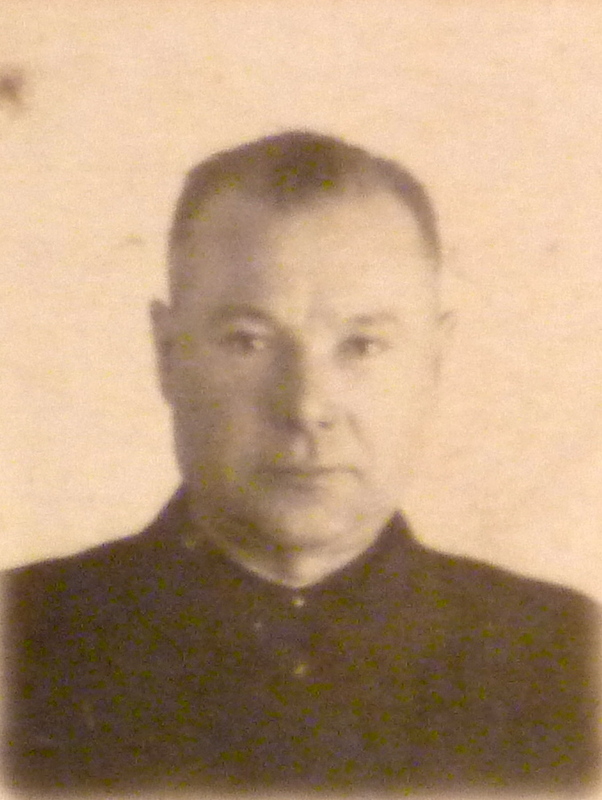
Andrei Nikiforovich Meshyryakov, born in 1906, in Novorossiysk, in the family of a riveting master. And since in Tsarist times highly professional labor was valued so much, they did not live poorly, and naturally the son followed in his father’s path. He first worked as a rivet heater from the age of eleven and then as an assistant. Large-diameter pipes and tanks were assembled only by riveting, and the assistant was given the honor of sitting inside that very pipe or tank as a massive backing block, supporting the rivet from inside while the masters hammered the preformed head with mighty hammers. Somewhere among old papers remains his old certificate from those years: “Riveter, the deaf riveter.” My father heard poorly with one ear, and in the other there was a constant cricket-like stridulation. So on walks when we spoke, I had to walk only on the left. Before the war, father graduated from a technical school with honors and worked as a foreman in Kemerovo at the Azot trust factory. For those in the know, it produced powder. Vivid memories remain of his stories about sabotage in the workshops and explosions.
With the outbreak of the war and the first sabotage explosions, the powder-production buildings were broken into smaller units and fragmented. They were scattered across the yard and made with blow-off roofs and external lighting only. So that in an explosion the roof could fly off easily and the equipment would not suffer from overpressure. Each workshop was edged on all sides with high earthen embankments. And light was supplied to the workshop only through windows by outside floodlights. One of the most dangerous operations was pushing through cotton already steeped in a mixture of nitric and sulfuric acid and washed with large amounts of alcohol and ether, in syrup form, through the filters. This pressing was done by a screw machine like a meat grinder. The process was continuous. During the kneading of the not-yet-cut “macaronni”-like powder, it froze very quickly halfway and, during extraction and cleaning of the mechanisms, it could easily ignite, because one had to act without delay. Meanwhile, wagons of the train already stood on the tracks with a fresh batch of powder from the previous day, ready to be sent to the nearby shell factory, waiting until the factory range fired a control batch of shells charged with this powder. Continuous firing from guns of different calibers went on day and night. Sometimes the powder “did not take”. The whole consist is unloaded, and just-manufactured powder is burned. If German intelligence managed to blow up such a train, all production suffered. In general, father said, after accidents or sabotage at the plant, mostly blind people came through, with knocked-out eyes. They came with guides, their heads bandaged. After serious explosions, almost by columns. So he worked on powder plants until the end of the war, and at times lived in a workshop for months without leaving the gate. “But there was plenty of alcohol and herring,” he concluded of that time.
And the Meshyryakov line came from the Don Cossacks and very likely from Matvei Meshyryak, assistant to Ermak Timofeevich. In 1965 we visited Krasnodar, where my father’s brothers and other relatives lived, and at our first embrace it sounded: “We are the Meshyryaks!” And my great-grandfather, a roguish fellow, from what my mother said, was notorious on the Volga for robbing merchants. What was, was…
Undoubtedly the ancestors’ genes show up in descendants somehow, and that manifested in me and Valya. She always studied brilliantly and diligently and even today, advancing science, teaches at Krasnoyarsk University. As for me, clearly inclined to moderate adventurism, I went into the Air Force as an officer, served 28 years in the Soviet Army, worked 18 years in civilian life, and have been idling for a long time.
I remember my preschool years fragmentarily, with many details, literally down to a leaf from a tree; I even remember a series of taste sensations, but I cannot link them by years. I remember Kemerovo snow; it was reddish from industrial emissions. I remember clearly my father’s big metal motorboat and the stationary engine installed in the middle of it. It held five to six adults. A hunting trip with my parents to the other side of the Tom was unforgettable. I remember very well a huge blackberry bush with large grayish-blue berries and father’s hand pointing to a nightingale that I never saw. And he, according to my parents, let us come very close. A wonderful huge wooden box with spare parts for the motor stood by the wall, and I never moved away from it, constantly sorting things in it. It was the best toy in the world to me. I remember even the faces of Japanese prisoners, their clothing, surprisingly light for a Siberian winter, their wrappings, some not very thick greatcoats and kepi caps in their uniforms, all with a little red square cockade.
In the freezing December of 1946, we were moving from Kemerovo to Barnaul and stood at some station. Through the window I could see a train beside it of Pulman wagons loaded with sugar beet. Pulman wagons are large four-axle wagons open at the top. Before the war freight wagons were mostly short two-axle ones. Suddenly, from somewhere under the wagons, nimble Japanese men began to jump up, all narrow-eyed, climbed onto these wagons and dumped beets down. Their comrades immediately collected it into armfuls. Somehow it stayed in my memory that they were not ragged and torn, but somehow identical, neat, all the same color and height, with the same headgear with ears flopping down.
The Barnaul summer was dusty and hot. Among summer pastimes, the main one was making tarantulas come out—rather, blowing them out of their burrows. It was important to gather a solid crowd of boys with a strong reserve of nerve. We stood together in a circle over the hole and started blowing into that same burrow in unison. In about ten seconds a crazy, furry spider shoots out; the weaklings drop out, and the remaining braves try to whack the spider, which is not easy at all. Very quick, very.
The boys’ favorite treat was korm (press cake). Maybe we lived very poorly, or they used to press the cake less before, but I remember its taste with pleasure even now. But the tastiest, truly indulgent treat was a thick slice of very white, excellent bread, spread with butter and generously sprinkled with sugar. Glorious stuffing! But I always wanted to eat it not at home but outside, on the move, with the boys.
I will begin to remember seriously from 1947. At the end of summer, somewhere in August, we moved from Barnaul to the old Ural city of Kyshtym and rented housing in a solid private house with heavy, massive gates. The yard was paved with gigantic granite slabs, between which dense dark-green grass grew in. We lived there three to a place, without my father. He appeared very rarely, probably once a month. At that time he was already working in the closed city of Chelyabinsk-401, while the permit for me and Mother was being processed, which took more than one month. Future installers and future operators of atomic facilities were recruited mainly from chemical plants. Father laughed when telling me that Beria, the curator of the atomic project, thought five thousand workers would be enough.
In winter in Kyshtym, the boys’ favorite amusement was to latch on to the rear side of a truck with a special hook and dare to ride behind it on metal skates. These were metal skates with an upturned tip and a rigid platform for any footwear, with matching holes for ropes. With those ropes the skates were tied very tightly, usually to felt boots—the most common winter footwear—using wooden twist-sticks. I remember roaring Valya: someone had prompted her to lick the gate hasp in the severe cold…
The permit for us came through, and a Studebaker arrived to pick us up. We had very few things, and it was not so far from Kyshtym to the Forty.
From May to October 1945, work was carried out in the Southern Urals to search for a construction site for the first atomic reactor. The site had to be not merely optimal in production-technology terms, but also meet requirements of external secrecy. Search work was conducted over a vast area in the eastern foothills of the Urals, around the chain of the Uvilda lakes in the south and Itkul in the north. The stopping point was the area between the towns of Kasli and Kyshtym: on a large promontory on the south bank of Lake Irt’yash—this is between Kyshtym and Kasli, near the old Demidov road that ran along the eastern and southern banks of the lake. Earlier, there had been pioneer camps and auxiliary farm operations there.
Footnotes
-
Later, Chelyabinsk-65, Ozersk. On July 19, 1948, the first industrial uranium-graphite reactor A for weapons plutonium production was brought online in the USSR. On that same enterprise (its first name was Combine No. 817, now PO Mayak), over the years 4 more reactors were also built for weapons plutonium production.
My father always called them “boilers.”
On April 14, 1949, the first ingot of metallic plutonium was obtained at the metallurgical plant. “When you hold it in your hands it gets warm nicely,” recalled Mikhail Stepanovich Dorokhov about his work in the first group of young chemists engaged in the final plutonium operations in the early years in the “Forty.” Before enough material had been accumulated for the first bomb, the first dead appeared. Of 22 employees in his group, in total, including those being treated at the clinic on Govorova 6, 20 died.
In August, hemispheres of plutonium were manufactured and sent to Arzamas-16 (KB-11) for assembly of the device.
On August 29, 1949, the first detonation of the Soviet plutonium atomic bomb, with a yield of 20 kilotons, took place at the Semipalatinsk test site.
On 22 December 1951 in Chelyabinsk-40 reactor AI was launched, intended for plutonium-scale production of superheavy hydrogen (tritium), used in creating a hydrogen bomb.
On August 12, 1953 the first hydrogen bomb was detonated (power 400 kilotons).
↩