Chapter 2 of 29
Sorokovka
SOROKOVKA
And so we were in Chelyabinsk-40, settled on the second floor of a two-story house at the corner of School Street and Stalin Avenue. In the yard there was a long wooden shed where the residents kept firewood and old odds and ends. Behind the shed in a grove stood two wooden cottages, called by the residents “Muzrukov’s dacha” and “Kurchatov’s dacha” 1. Everyone seemed to know General Muzrukov, but no one, as we boys thought, seemed to care what kind of man this Kurchatov was. Both dachas were enclosed by a fairly high shared wooden fence with a guardhouse. I visited Muzrukov’s place several times as a guest of Kolka, the general’s son and my desk mate. I remember the large chandeliers and the almost ten-kilogram metal model of some heavy tank, placed in the place of honor in the entry hall. Dad said that before the “Sorokovka” period the general had run Uralmash 2. A masterpiece of a miniature model, a real showpiece.
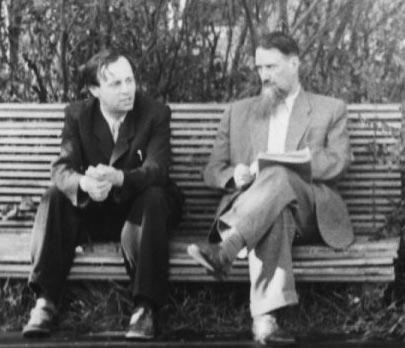
A.D. Sakharov and I.V. Kurchatov
And if you go further down School Street, past the “dog institute,” you reach the bathhouse. For me the bathhouse meant not washing but checking out original tattoos and severe wounds on the bodies of bare-chested men. After the bath, dad would slowly drink a mug of barrel-aged beer, blowing off the white foam cap, and buy a couple of kilograms of peanuts. Mother roasted the peanuts in the oven, and they were especially good hot, almost burning. The “dog institute” was a large fenced area, maybe half a football field in size, with some barracks and countless two-story dog kennels and endless barking. Only now I understand what kind of institute it was and why there were so many dogs.
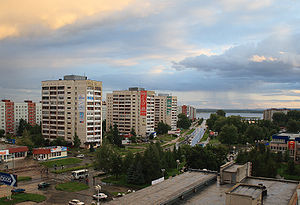
New and old districts of Sorokovka
The building was brick, with central heating and a wood stove for cooking. The kitchen windows looked into the yard, over the shed, so mother often saw the mischief we caused in the yard. In the neighboring house lived a rowdy red-haired Petka Gordon. In quarrels we of course teased him as “gondon.” He was tall, a bully, older than us, and the leader of the courtyard.
Stalin Avenue was being built from the lake. Near our house stood a fenced area of about fifty by fifty meters on freshly tarred posts, with watchtowers with ladders at the corners; on the second day they would bring in prisoners and excavate a pit for the foundation. In the evening the ziki were taken away, and the guards left, leaving the site for us. For some reason we called the prisoners not “zeki” but exactly “ziki.” In the evening, after the prisoners were led off, it was fascinating to walk through the almost finished building. They lifted some vents for structures of earth, creating intricate palaces and castles with chimney systems. I then tried to make the smoke flow in unimaginable zigzags and tunnels. I got close with the guards on the towers. They let us into their place. Out of idleness, the soldiers were making various things. One gave me a gymnast cartwheeling on the bar. Mother fed the prisoners; Vala and I usually passed through the wire some bread and sausage. Once the prisoners gave us two dining-table-sized aluminum spoons, inlaid with glass or even semi-precious stones, with our names on them. Museum-grade objects. They disappeared somewhere during moves.
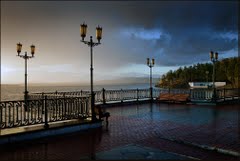
The main street of the city, Stalin Avenue. Today such a street would be called a boulevard. The broad boulevard was a beautified strip of taiga with huge pines, fenced by delicate Karly forged grilles. At intersections stood enormous oval convex mirrors, probably for traffic safety. And this was in the fifties. Once a powerful storm swept over the city and some trees fell across the road, stopping all movement. For the boys it was freedom and fun.
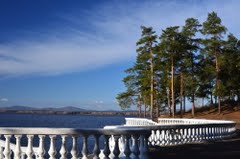
The avenue begins at a beautiful embankment of a large lake. I do not remember the lake’s name 3, but I remember the name of our pioneer camp on this lake—“Akakul.” I often used the word beautiful, though “very beautiful” would be more accurate. Not only Sorokovka but all the other cities of the Ministry of Medium Machine Building were clearly designed by the best architects in the country. The fact that they were built on prisoners’ bones and suffering is terrible, but that is another and much more serious question. Concluding the urban-planning theme, I will say this: whoever has never been in such places and does not suspect cities can be this clean, convenient, and beautiful 4.
In first grade I went to school No. 1, and from fourth grade I was assigned to music school for violin class. Vala was also put in a musical harness as well; they bought a piano, but she somehow got away from the lessons, perhaps that lowered her status as a model student at school or some other consideration later freed her from that business. My first specialized teacher was Veksl er. He had fought in the Finnish war and lost toes. He clearly wore shortened shoes. I can still picture him vividly, with scratches and wear. He was below average height, with a characteristic nose—a flattened potato shape from the side, that is, with a hump. He was always in a plain black suit, apparently not a high salary. He always had the Order of the Battle Red Banner on his lapel. We knew he played in the orchestra of the city drama theater. A very kind uncle.
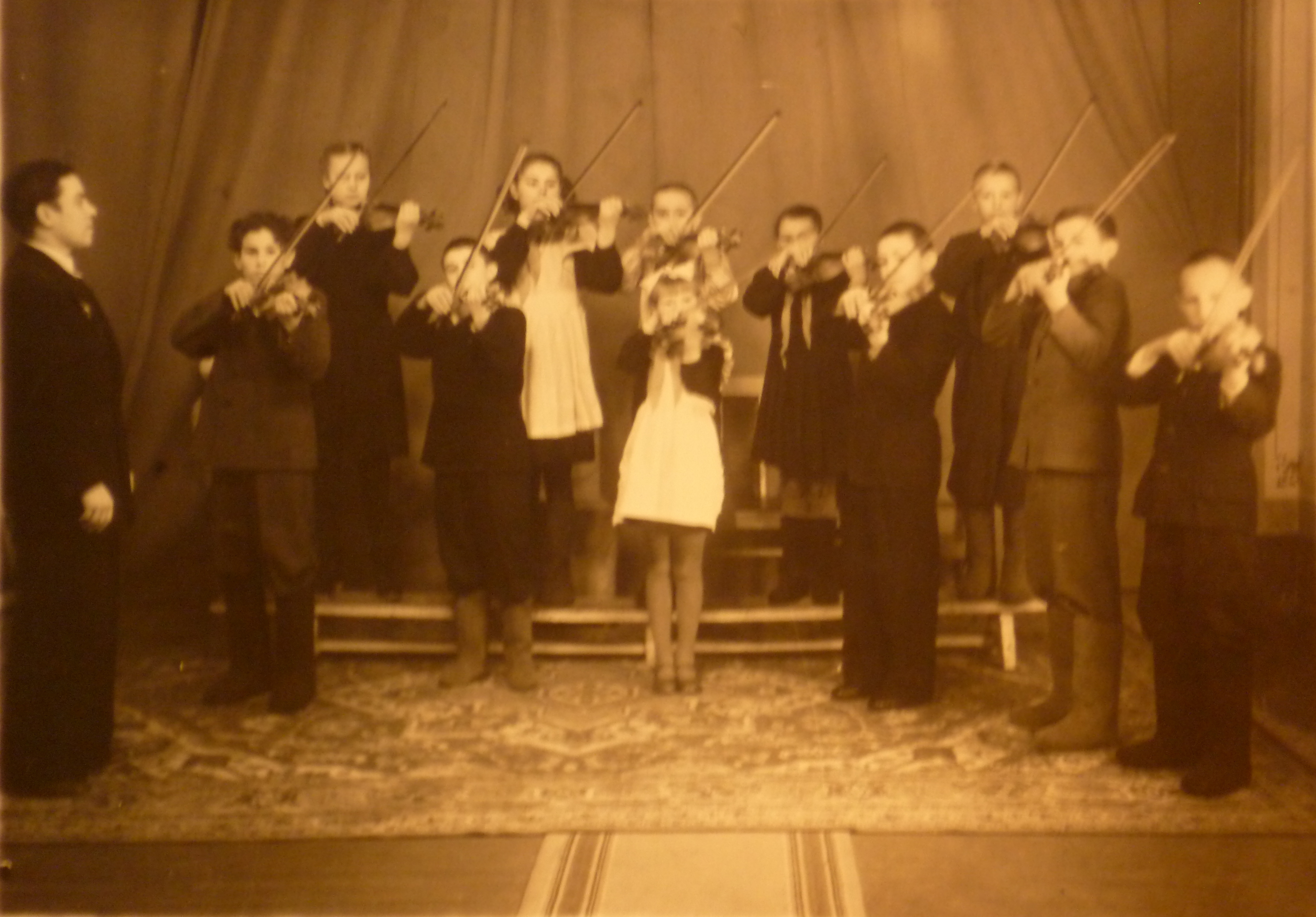
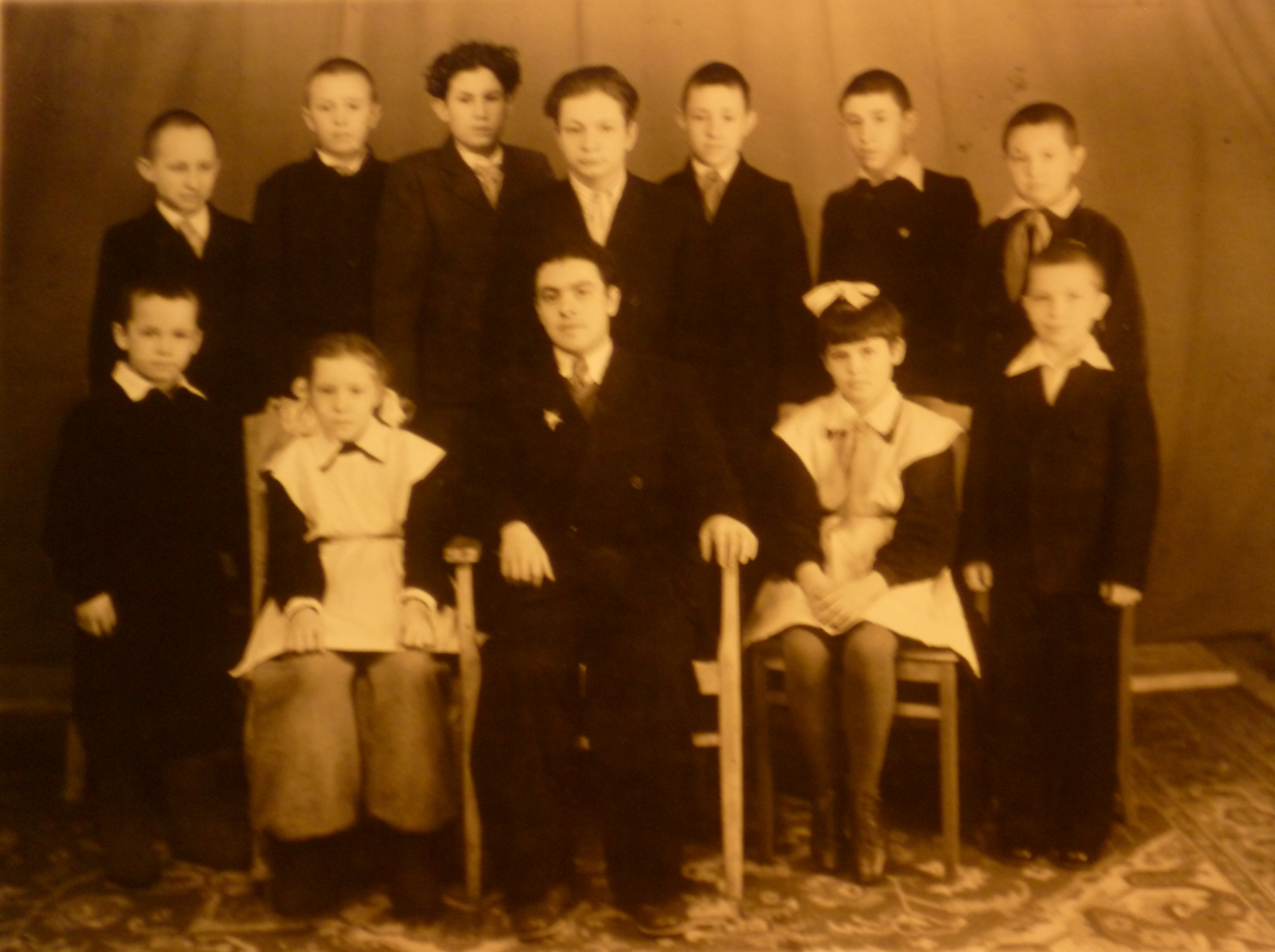
The homeroom teacher at the comprehensive school, Rema Alexandrovna, was memorable not only for her extremely vividly made-up, powdered appearance and high pompadour of whipped black hair, but also because she pushed us to take Russian language studies seriously, saying that it would very soon become the main international language. No more and no less. In this way, school, with its authority for a child, helped to raise in Soviet people a feeling of a special role in history, a tendency toward self-isolation, and intolerance for other ideology. That is where the party worked. As our current troubles show, this was deeply ingrained in the people’s consciousness.
From first grade I made wall newspapers and similar visual propaganda (up to the 10th grade). I had to draw caricatures of slackers and truants, including myself.
I got into stamp collecting. I remember some wonderful little stamps. A beautiful series of pilots—conquerors of the North—and stamps with city-building plans for the capital. Many stamps had diagonal overprints with the new NEP-era price. Especially the Volga famine series. The new printed price of the standard stamp, according to the overprint, was from 100 000 to 1000 000 rubles. And the stamps of Tuva! And artistic reproductions! I consider philately one of the most serious, worthy, and developing hobbies, which, unfortunately, has always been completely beyond my reach for material reasons. In the north, in Plesetsk, I tried for a couple of years to break into collecting, but no such luck. I could not keep up.
I was active and, naturally, secretive, studying gunpowder and explosive work. Fortunately, dad had plenty of black and smokeless powder. I cooled off only a little after a failed detonation of a zinc canister from a KBS-type battery packed with black powder. It was roughly a quadruple loading of a hunting cartridge. It went off so hard it burned my left eye badly. To this day, on a clear day, I can see little floating threads and knots with my left eye. Well, if we are talking about gunpowder, then I should also tell you about the opening of the new city stadium “Khimik.”
The stands were full to capacity, marches and spirited songs thundered. As a warm-up a remarkable number was prepared. Brave lads ran onto the field, red-shouldered soldiers, our guards, and began to perform highly coordinated, perfectly synchronized drills with rifles with fixed bayonets. The crowd greeted this with friendly applause. They had drilled them well. And then, finishing the last step, that same hundred fired a perfectly synchronized volley from all barrels. The roar of the volley from three-line rifles was so powerful that the audience jumped as one, exclaiming something like “Ah” or “Oh,” and then swore in chorus…
And a bit more about gunpowder. We all went as a class to the premiere of the children’s play “The Flower of Seven Colors.” I do not remember the all-conquering love, what sort of origin the girl had to the boy turned monster. The poor one was dressed in a bear skin, cried horribly, yet spoke very clearly when it came to the point. In the most climactic moment, a young woman begins to wave a large red flower and speak some incantation. She does not simply move her hands, but follows a very specific trajectory, circling the flower in a wide loop. Finally, when she finishes her speech about tender love for the creature and touches something near the floor with this flower, the lights in the hall and onstage go out, a faint scuffle is heard, and an explosion crackles with a very bright flash. Immediately the lights return, and the stunned audience sees the smoke-stained happy girl and beside her an equally terrified prince. She broke the spell. And a huge spherical cloud of bluish smoke appears. Then it smelled of hydrogen sulfide. When I told Dad about this fireworks trick, he admitted these artists had borrowed smokeless powder from him and probably miscalculated the charge.
After first grade, in summer they always sent me to the Akakul camp, sometimes for two sessions in a row, which is about a month and a half. At the pioneer camp I got hooked on fishing. As line we used ordinary black thread. We fished with flies and white bread. In the Ural lakes there are many crayfish. In the lake we caught them by hand in unimaginable quantities and in washing tubs, and turned them in to the kitchen. At the end of the shift they held a huge bonfire. I still remember the songs blasting from the camp speakers—“Eh, little road, front line road, no bombing can scare us…”
And once we wandered to some body of water whose banks had big red signs with strict prohibitions on catching fish and crayfish. I saw crayfish in that lake or river roughly twice or three times larger than usual. They moved very slowly, and moss grew on their shell. Perhaps this was the now infamous lake Irtyash or Karachay 5, turned into a settling basin for liquid radioactive waste from the chemical reactor plant. Dad later said that at this lake there was a hunting squad, shooting all kinds of game that turned up on it year-round.
Our floor neighbors were the Ievlevs, with two children, our age peers with Vala—Galka and Vovka—we became close friends.
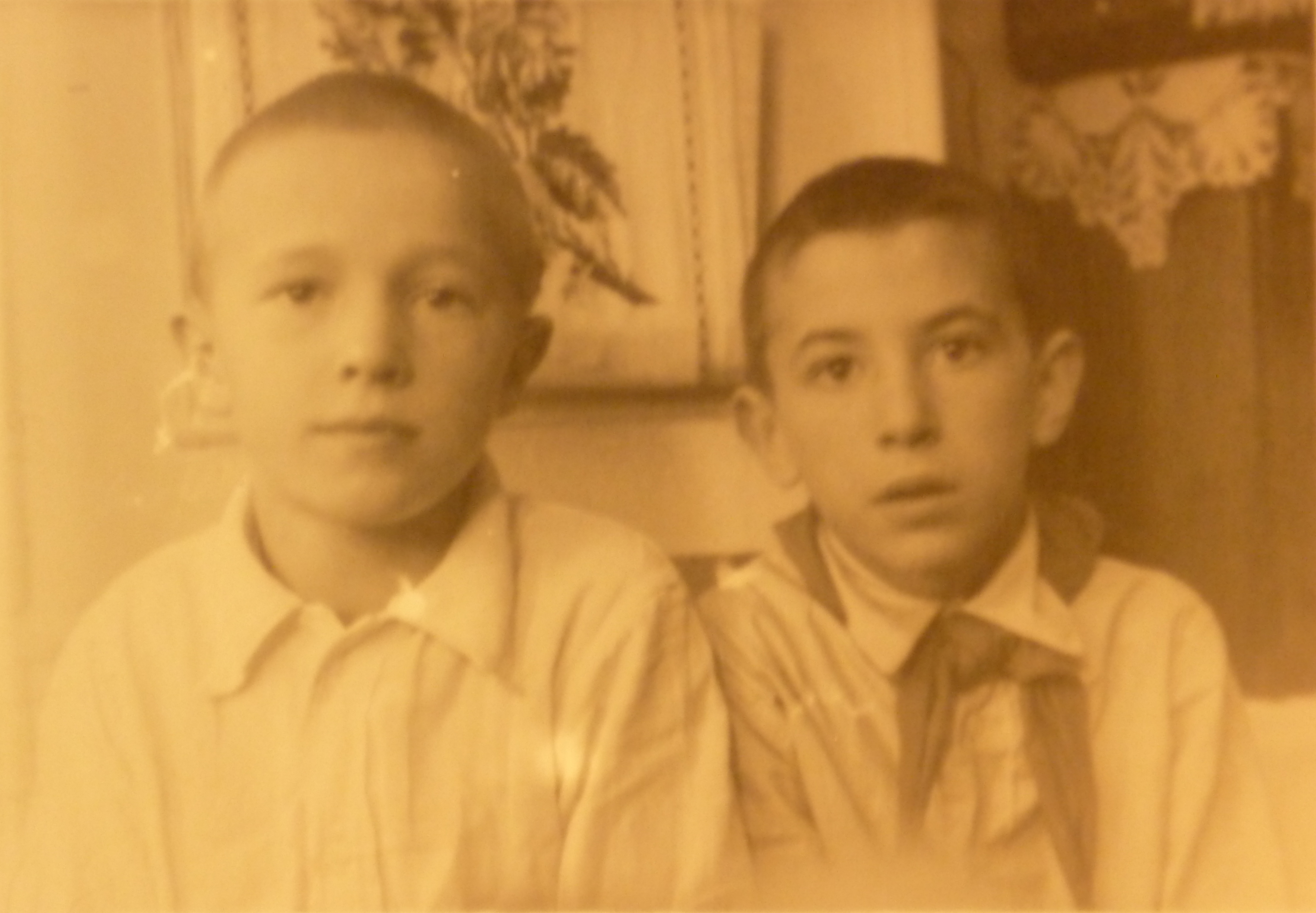
With Vova Ievlev
Boris Dmitrievich served as chief of staff of the guard regiment of Sorokovka and, like my dad, was a keen hunter and fisherman. Sometimes we went as families by patrol military boat to Sokol Island for fishing. The boat was small, but a machine gun stood on its bow. The island, like almost the entire shore of that large lake, was a jumble of huge boulders covered with scrub and trees. But from all sides of the island there were immediate depths rich with very large fish, mostly kilogram-weight perch.
Under one of the island’s rocks there was a small grotto with a cave that continued somewhere under the island underwater. In this cave a whole school of very large perch was based. In front of this grotto there lay a huge boulder with a platform protruding above the water surface of about two by three meters. By some method, perhaps swimming, I got onto this platform, and father, from above on the cliff, handed me line with a bundle of worms tied to a large hook, which I tried to cast far into the grotto, onto the submerged slab, like a table. The slab, with a slight incline, continued further into the cave. Without paying attention to me, from the cave two or three hunched fish emerged very slowly and steadily; one of them took the bait, I gave the command, and I watched the short struggle between man and fish. In fact, there was little real struggle, because the “table” was only at a depth of no more than twenty to thirty centimeters. From this cliff of the island I once saw a pike, as long as I thought, about two meters and with matching thickness. It stood still for a moment, its body tilted into the depth, then slowly “sank.” I have never seen anything like that again.
In winter fishing, what I remember was the serious thickness of the lake ice. In those days there were still no auger ice drills; the hole was cut entirely with an adze. And to scoop out the broken ice from the deep hole, dad lay on the ice.
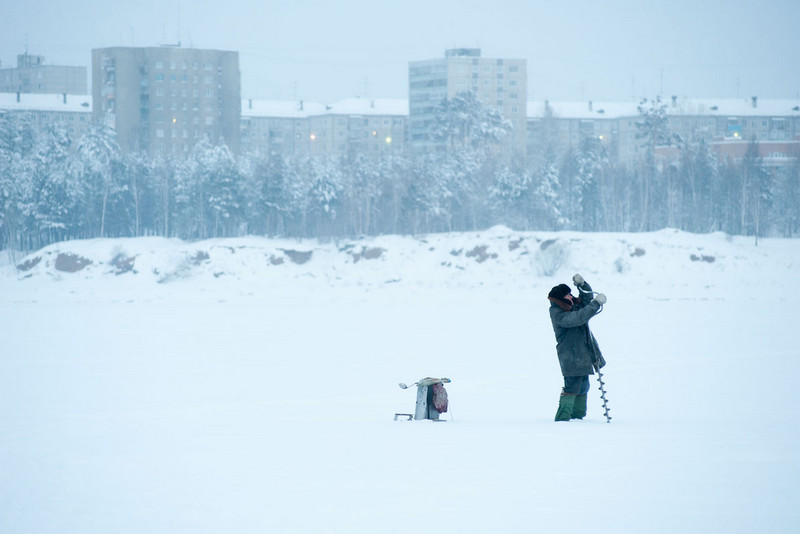
Now it’s easier to drill a hole in Sorokovka…
March 53. The city was in mourning. The Leader of all peoples had died. Mourning music played from all loudspeakers. We were also forced in music class to play some sad melody. It fell to me to squawk out “The First Loss,” I think by Schubert.
Footnotes
-
Igor Vasilievich Kurchatov (30 December 1902 (12 January 1903, Simsky Zavod, Ufa Province — 7 February 1960, Moscow) — Soviet physicist, the “father” of the Soviet atomic bomb. Founder and first director of the Institute of Atomic Energy from 1943 to 1960, chief scientific leader of the atomic issue in the USSR, one of the founders of using nuclear energy for peaceful purposes. Academician of the Academy of Sciences of the USSR (1943).
↩ -
B. G. Muzrukov, director of Uralmash Plant ( 9.11. 1939 – 3.12.1947).
↩ -
Lake Irtyash.
↩ -
1957. September 29. The “Kyshtym” nuclear catastrophe. A thermal explosion of a container with highly active waste at the “Mayak” chemical combine (Chelyabinsk-40), which caused a release of radionuclides with total activity of 20 million curies. The radioactive trace formed by the explosion extended east of the combine for 1000 kilometers. Radioactively contaminated territory amounted to about 20 thousand square kilometers with 217 inhabited localities, in which 270 thousand people lived. All these people received doses above the permissible annual levels. The population (more than 10 thousand people) was evacuated only from the most “dirty” parts.
↩ -
1967. During a prolonged drought, the water level in Lake Kara-Chay, into which liquid medium- and high-level wastes from the radiochemical plant of the Mayak combine were discharged, dropped, and the lake banks became exposed. A hurricane that passed lifted contaminated radioactive mud into the air and spread it over considerable distances. All this led to contamination of the natural environment over an area of 1.8 thousand square kilometers. The wind transport of radioactive aerosols repeated in 1972.
↩