Chapter 3 of 29
Tomsk-7, Tomsk-13
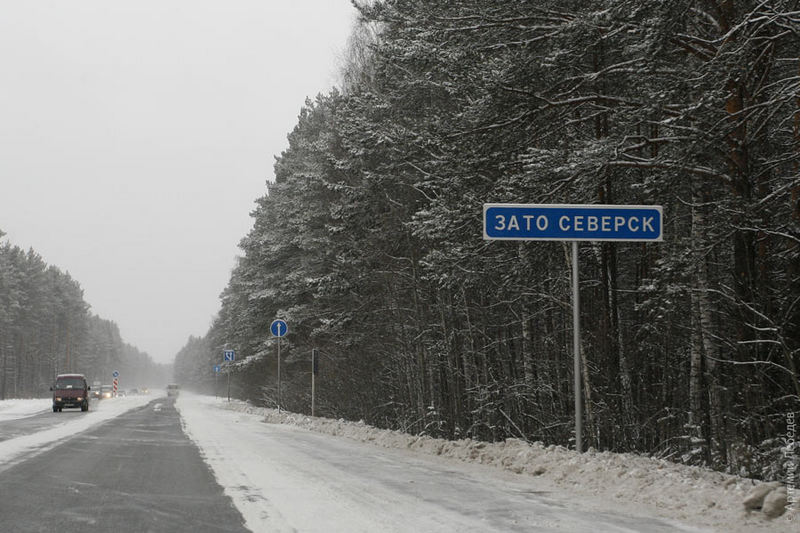
In 1953 we move to Tomsk-7.12 This is also a closed city under the same ministry.3
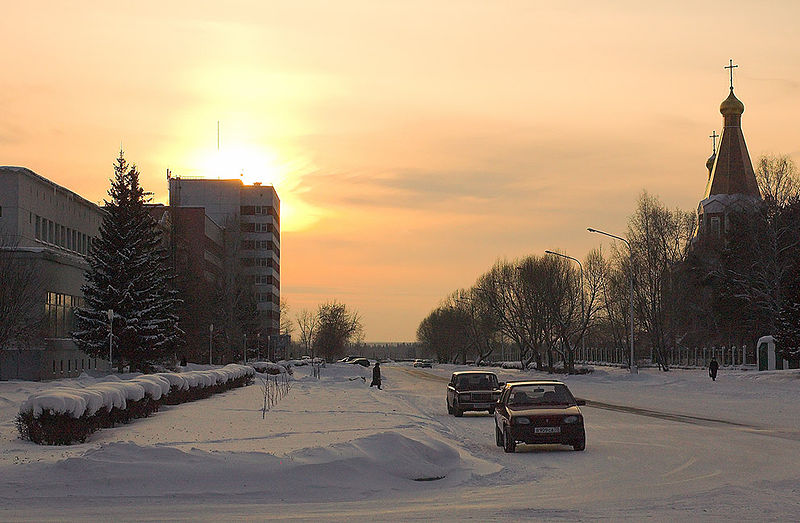
Kurchatov Street
We settled in the Chekist settlement4, on the second floor of a very warm two-storey cinderblock house with a huge loggia. Later, a billiard table appeared on that loggia. Dad understood the game. The billiard table was large and covered with grey cloth. It could be covered from above with two panels, and then two people could sleep on those panels. I could never quite acquire the main quality Dad possessed in this game: unhurriedness and thoughtfulness. Billiards only seem, at first glance, to be a simple “flat” game. In life I met boys who seemed as though they would never learn to roll the balls brilliantly. I did not get far beyond them myself. A year later, my father gave me a small single-barrel twentieth-gauge shotgun, my first gun. On one of our trips to hunt hares near some village, I shot several sparrows with a single shot. Mother prepared a wonderful dish from my first catch; the carcasses were microscopic, it is true, but we solemnly ate them. During those same years I first tried smoking and drinking wine. More precisely, we smoked quite steadily and often, but we smoked pipes, and instead of tobacco we had to make do with crushed dry birch leaves. The pipes were not homemade. At that time this tobacco implement was quite readily available for sale. And smoking proper tobacco was very enjoyable. First, it was “like an adult”; then there was the forbidden aspect, and the process itself was very manly. Birch tobacco was of course disgusting. But one had to smoke anyway! And with me were my inseparable friends Tolya Sidelnikov, Valera Dmitriev, and Borya Vasilyev. As for their appearance, they were very different. Tolya was broad-boned, fair-haired, and very solid and thoughtful. Valera was dark-haired and brown-eyed. Both played chess well. But Borya contrasted sharply with us in everything. His figure, and especially his pure white, almost girlish skin, and his face, resembled the face of Gogol’s Chichikov absolutely. Plump, soft, and neat. I knew his parents poorly and cannot say whether they forbade him to associate with boys like us or, on the contrary, encouraged his attraction to us.
And in the sixth grade our little group drank an entire bottle of 07-litre port wine. We drank in the attic of the house. We went home and quietly went to bed. In the morning there was a scandal and an interrogation… Borya felt ill during the night and “spilled the beans.” We got up to mischief. As soon as it grew dark, the group would go and set up a “knocker.” Its components were a drawing pin, a potato, and a spool of thread. The pin, with the thread attached, was stuck into the window frame; half a metre below, the potato was tied to the thread, and then the thread ran at full length into the bushes or over the fence. The main thing was not to get carried away, not to hammer from the shoulder, but to knock gently and with pauses… From time to time we tied two opposite doors on the floor together with a strong rope and rang each one… But the most interesting forbidden pastime was making firecrackers and shooting them. This was not the primitive bang-maker popular with boys, made from a tube bent at a right angle and packed with match-head powder, a rubber band, and a crooked nail, but a more complicated construction. In time we began making our pistols resemble antique duelling pistols. The barrels were made from copper tubes, however, and the effective range of a shot was no more than 30 metres. But the roar and smoke were just like the real thing. The powder was black powder, after all. We experimented a great deal with little bombs fitted with Bickford fuses. You packed a rifle cartridge case with powder, crimped with pliers a piece of Bickford fuse inserted into the case, about five centimetres long, with a proper diagonal cut at the ignition end. It worked perfectly even in water. There was no shortage of powder; many fathers were hunters.
To the foot of the bluff, on the edge of the marsh where the boys and I engaged in explosive activities, the “red-bands” sometimes came, or rather regularly: soldiers bringing young sheepdogs for training. The lucky one, in exchange for the promise of being allowed to fire a carbine, put on special quilted padded trousers, a matching padded jacket, and ran! Two or three sheepdogs on very long leads came running after him, barking furiously. The first time it was quite frightening. My feet were in ordinary shoes, practically bare. And the soldiers kept egging the dogs on and shouting that I must not stop and, most importantly, must not shout at the dogs or fight them off with the padded jacket I had taken off because it was unnecessary and hot. The fugitive’s behaviour had to be cowardly. Dogs, especially young ones, were taken aback by such resistance from the “criminal” and crouched down, which was completely uneducational. They were young, of course, but their muzzles and fangs were already something else. If they formed a ring around you—and they were always trying to do that—it was very difficult to restrain yourself from screaming and instinctively swinging the padded jacket to protect yourself… But at last the dogs grew tired. The stage of accustoming them to the sound of gunfire began. In your hands you held a real army weapon loaded with real cartridges. Bang, bang, bang! And what a powerful recoil!
Twice a week I was taken to Tomsk for music school (Dad already had a service “Moskvich”). The city music school occupied the same building as the music college and, probably because there was not enough room, students practised everywhere and on every instrument, from the flute to the double bass, in every conceivable nook and cranny, under the stairs, in the lavatory, at any time of day and possibly at night. They were detached, utterly absorbed, and, compared with my diligence, simply fanatical. The building was filled with a continuous cacophony, and there was no escape from it; everyone was used to it. But it got in my way. As it turned out, I had perfect pitch: I identified every note I heard automatically and unambiguously. The teachers quickly discovered this, and during dictation lessons, after the first introductory performance of the entire melody, they immediately sent me out of the classroom because my classmates would instantly try to copy it from me. When Mother learned about this gift of mine, she became completely convinced of my brilliant musical future—but in vain. I cut corners, tormented the instrument and the teachers, and came to lessons without having deigned to prepare. This was not my calling; my ear had gone to the wrong person.
Whenever free time presented itself (a teacher had fallen ill), I would invariably walk around the centre of this ancient city. I often went into the pharmacy and invariably stared at the artificial eyes displayed on black velvet. They lay in rows in a huge box, about fifty of them, no fewer, in different colours and sizes. They were made primarily of white porcelain. All astonishingly similar to real eyes, and I wanted to look into those pupils forever; they exerted some kind of attraction. I have never seen anything like them anywhere else.
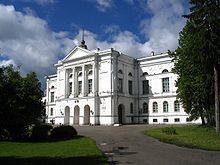
Tomsk State University
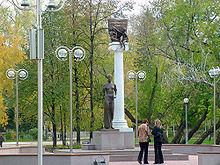
Tomsk State University and the monument “Tomsk Students” on Novosobornaya Square.
In winter we would stop at the collective-farm market to buy various things. I remember sledges full of pink hare carcasses, and there were always many such sledges. The villagers brought milk in large sacks shaped like frozen one-litre bowls. And masses of frozen fish of every possible kind. Since I have mentioned fish, I must also mention one of the main pastimes of Tomsk boys, of course: fishing. If I was not sent to a pioneer camp, I could most likely be found on the river. Steamers travelled along the Tom, but they were rarely screw-driven; mostly they were paddle steamers, slapping the water with wooden paddles. I remember the name of one of them: “Syktyvkar”. There was something complicated and indecent, it seemed, in that word. Near our access to the river was a large log pond, and on the high bank stood a gigantic timber yard. In truth, all timber yards, without exception, were always cyclopean in size. Endless stacks of logs, hundreds of metres long and wide, and ten metres high or more.
In those days timber was floated exclusively on rafts or by mole, that is, under its own power. The most barbaric method. The logs were caught at the necessary points by booms made up of long chains of narrow rafts. Each raft consisted of four or five good logs firmly fastened with brackets. One end of this bundle was secured to the bank, while the other was firmly anchored somewhere near the middle of the river. Such a bundle could be more than one hundred metres long. Logs drifting freely with the river current accumulated in these booms over enormous areas. We fished and swam from these booms. We caught many good gudgeon while wading. Later we fried them uncleaned over a fire, hanging them vertically on a stick driven into the ground at an angle. Delicious! We fished with worms, flies, or grasshoppers. We dug for worms in the bird-cherry grove; there was a sea of them there, but even more mosquitoes. We protected ourselves from the mosquitoes with the Czechoslovakian ointment “Repudin”. A pungently aromatic liquid resembling glycerine. We obtained it from the military, from the guards. A radical remedy. And the native Tomsk fishermen had, since time immemorial, smeared their faces and hands with fish slime to ward off gnats.
With our parents’ permission, we went on a four-day raft trip. Naturally, without girls. The raft was made like this. Go floating, choose a log you like, tow it to the bank, fasten it with brackets, and cover it from above with boards. We built it in half a day. We even made some sort of gangplank for something. We stocked up on mosquito ointment, mess tins, fishing rods, and provisions. For the most part, our parents stuffed us with cans of stewed meat and condensed milk. All four days the weather was hot. We swam practically nonstop, mostly while moving, in deep water. When we came ashore, nobody wanted to bother cooking. We simply opened tins, cut bread, and, as the most complicated task, boiled water with currant leaves. Since we ate no more than twice a day, we lost a little weight and grew weak, and the heat also sucked the strength out of us. We could have done with something salty to eat now and then. We did not travel far, since we had to walk back. That was hard, mainly because of the heat; we carried the uneaten cans, and we had also foolishly drunk raw water from some canal flowing from the direction of the thermal power plant. When we drank it, the warm water had some strange aftertaste. But we were terribly thirsty.
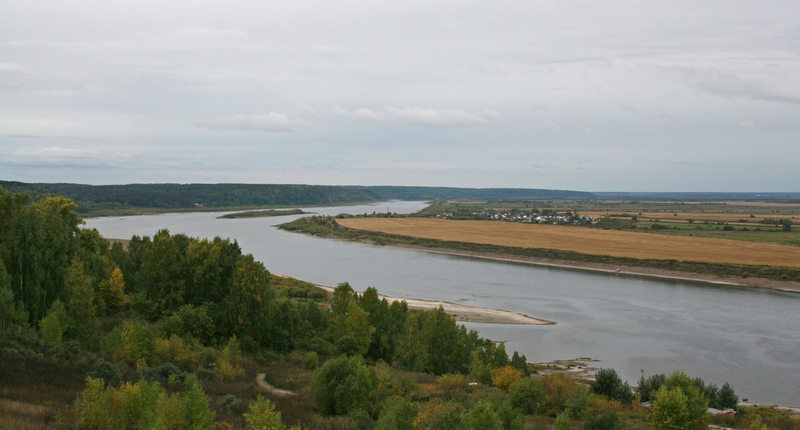
The Tom
Several times my father and I went out by boat to fish in the Samusky and Moryakovsky backwaters. The boat was military, as it had been in the “sorokovka”. But without a machine gun. And once again, our neighbour in the new flat, now in Tomsk-13, which was still within that same common zone, turned out to be a fisherman and hunter, Major General Shemina. He had a very young and striking wife, Valentina. At lunch he himself ate a huge head of garlic, as big as a fist, and never peeled it, simply spitting out the skin.
It was on his service boat that we went on our expeditions. We did not spend the nights on the vessel, but always stayed with the same hospitable natives, former front-line soldiers. Evidently it was a very close-knit family. The owner, a front-line soldier, infantryman, and captain, had returned from the front without his right eye, and on his right hand he had two practically immovable fingers left, shaped like a hook or a red beak. His father skilfully made a crooked stock for his favourite rifle, adapted to his right shoulder and left eye.
I became acquainted with the everyday life of the native Siberians, the Chaldons. They lived off fish, catching exclusively pike, smoking it in the smoke of an aspen-bark stove, and taking it to the market in Tomsk. They fished from dugout boats, locally called oblos. This was a wooden copy of a one-person kayak. More precisely, the opposite was true: the kayak became a copy of the oblos. It was impossible for a novice to sit securely in it, let alone fish. A Chaldon, however, sat in an oblos as if moulded into it, calmly hauling in pike and bashing them on the head with a special birch club to subdue them. Only an unceasing din hung over the channel. What quantities of fish there were in the Tom! Shemina’s driver, who was also his orderly, was an interesting man. He swallowed freshly caught small fish, minnows no smaller than an average finger, alive, without chewing or gutting them, after first lightly rubbing off their scales in the water! He took a fish by the tail, tilted his head back, and carefully lowered it into his gaping mouth.
Our first television appeared in 54 or 55; Father brought it from yet another business trip to Moscow. It was a “Temp”. Naturally, it was black-and-white, but with a fairly large screen, perhaps the size of a notebook sheet, or slightly smaller. In the USSR, in Siberia, the first regular, real television broadcasts were made by some Tomsk university. The polytechnic, apparently. It was its signal that we picked up. At first with a wire antenna in the large room, and soon with an aluminium dipole on an outdoor mast. The receiver had to be placed in the corner of the sitting room so that the broadcast could be seen not only by those sitting tightly packed on chairs and stools brought in from elsewhere, but also by those sitting and standing in the corridor. Half the building would come for a viewing. At first they broadcast only films, always new ones, including “trophy” films. Two films every evening without a break, and nothing else. For the tuning image, they transmitted a picture of the Kremlin star.
Interestingly, the first signal that my father and I jointly caught on a room antenna made of wire was the film “Alexander Popov”. Perhaps this influenced my choice of pursuits in life. But the television was not perceived as a receiver of a television signal. It seemed to show everything by itself. Even when there was interference or the image disappeared, the Tomsk transmission centre was perceived abstractly. Later broadcasts from the studio began. Once they transmitted a very long concert by a very strange and long Alexander Vertinsky. He stood in a tuxedo at a grand piano and sometimes helped himself in singing with an unusual, gentle conducting motion of one hand. I also remember a concert by Mikhail Alexandrovich. It was bel canto! (In the USSR, 70 records were released with recordings by Mikhail Davidovich, with a total circulation of 2 million.) The television studio was extremely hot, the spotlights blazed, and the guests never parted with their handkerchiefs, wiping themselves without interrupting a note. Later I learned that vidicons of those years required extraordinarily powerful illumination of the subject.
During those same years, a passion for reading was born, one that has not cooled to this day. Dad became interested in photography. From the sixth grade onward I did everything myself, from weighing reagents to making prints. Before the appearance of fully sensitized films such as “izopankhrom”, we managed perfectly well with “izoorto” and “ortokhrom”, which could be processed under red light. Dad and I even tried our hand at colour photography. I remember that some reagents were poisonous, with serious warnings on their labels. I attended an aeromodelling club and a fret-saw workshop, and read everything incessantly. When was there time for music or schoolwork?
Every summer, apparently for one session, I went off to camp. There were many sports and games at the camp, but on the whole it was less interesting there than at “Akakul” in the Urals, sometimes even dreary. But one day a large fellow in glasses came up to me and said: teach me to play the violin!? You see, he had heard me during a performance by the local amateur group, where they had persuaded me to play something. Evidently shaken by the playing of the “virtuoso” Oleg Pugovkin, he had become fired up and decided to learn, on the side, such a trivial craft. At the camp he worked part-time as a pioneer leader and was at least five years older than me. Or perhaps he only seemed so old because he was very large, wore glasses, moved solidly, and smoked with complete impudence. His parents turned out to hold some sort of Chekist ranks and had raised him to be exceptionally independent. So independent that from time to time he would take two personalized Brownings from beneath sheets and lengths of fabric stacked in a huge chest—his father’s and mother’s, both NKVD officers. We did not carry them outside, but we turned them over in our hands, clicked the triggers, and eagerly “aimed” at imaginary enemies. I certainly did.
There was always a packet of tobacco and a box of cartridge cases on the table in his room, empty, untobacco-filled cigarette blanks. And a machine for filling them with tobacco, shaped like a large trough—a tobacco reservoir with a fitting attached to it and a piston, onto which the cartridge case was placed. By that time I had finally given up smoking, and Oleg would not have allowed it anyway.
In short, almost every day—I no longer remember for how many hours or minutes—I began “giving lessons”. If only I had possessed such desire and diligence! For some reason I do not remember how far we got, but progress was very slow and hopeless. I kept waiting for him to grow tired of this endless business. I myself, meanwhile, began applying myself more seriously at the music school. At last I began to enjoy playing myself, especially the concertos by Vivaldi and Accolai. For twenty years I remembered their difficult chords and seemed to think that if I picked up a violin now, memory would bring everything back. No, of course not. I remember the beginning of a ballad Oleg composed about me: “At music school, music school, there’s a false note ringing, little Petya is squeaking on his violin…” It went on to tell how my subject teacher, Zamytsky, could not endure the terrible falseness and hit me on the head. Incidentally, some things in the ballad corresponded to the sad reality: I had been terribly lazy and negligent. I was supposed to practise for four hours every day. I practised for 15 minutes before the lesson. But when Zamytsky was pleased and in a good mood, he would take out from somewhere a huge piece of white bread with a slab of cheese half a centimetre thick lying on top. Very thick. He would slowly bite into it and, after each bite, invariably place it on the piano keys.
At the Tomsk music school I played in a large combined symphony orchestra for the first time. Combined because half the instruments came from the music college. It was an extraordinarily wonderful feeling to belong to a collective of very serious young musicians creating a complex work with my modest participation. But the very first “work” with which a newcomer to the orchestra is introduced is the marvellous melody “do-re-mi-do-re-do” with a reprise, that is, a repetition. The final “re” and “do” are twice as long as the other notes. With this phrase a musician expresses disagreement or displeasure. It works for every occasion. And if he has no instrument at hand, the notes are sung as in solfeggio. This unassuming melody literally means: “dear-com-rade, go-to-hell…” But the reprise is never used. In my entire musical career I never once heard the repetition.
Footnotes
-
The city initially had several names, one of the most euphonious being the settlement of Berëzki. In 1954 the closed city was given the name Seversk, but later, for reasons of secrecy, documents began referring to it as Tomsk-7.
People simply called the city “Pochtovy” because the construction of the combine was designated “Mailbox No. 5”.
Corrective-labour camps were established by order of the Minister of Internal Affairs for the construction of the combine. The prisoners worked not only at industrial sites; their labour was also used to build residential buildings and urban infrastructure. About 20 thousand prisoners worked on the construction of the closed city and the combine.
↩ -
1955. June 28. The Siberian Chemical Combine in Tomsk-7 produced its first batch of weapons-grade uranium.
↩ -
1955. November 20. The first industrial reactor, I-1, was launched at the Siberian Chemical Combine.
A total of 5 reactors operated at the Siberian Chemical Combine.
↩ -
In 1933, a youth labour commune called “Chekist” was established on the site of the future city (later, Corrective-Labour Colony No. 1 of the Siblag Administration of Corrective-Labour Camps and Colonies of the NKVD of the USSR); it passed its name on to the settlement where the city’s first builders lived. This district still bears its name today.
↩