Chapter 12 of 29
Leave of '64
The core of our team decided to take our August 64 leave at the same time and travel together. The first to set off were three friends—Lev Kostyuk, Vol Ambrasovich, and me—heading by train straight for the pleasant town of Melekess.1 Before retiring in 1963, my father had been allowed to leave Krasnoyarsk-26. He chose this quiet town where the Cheremshan, a beautiful river full of fish, flows into the Volga, even though he had also been offered the directorship of a small factory outside Moscow.
As arranged with my parents, we continued our journey in my father’s brand-new GAZ-21 Volga—a magnificent car by the standards of the day. Anticipating the almost unimaginable shortages, Lev and Vol had used their connections in “Kzyl-Paris” to buy a spare pair of Volga tires. We hauled them to Melekess by train and then carried them around for ages on the car’s back seat. I had driven the Volga quite a lot during my previous winter leave—about 3 thousand kilometers in December 63—so I set off from my parents’ home without a worry. Yet within the first few kilometers I was suddenly overwhelmed by responsibility for both the car and the whole venture. I began hearing unfamiliar noises from the suspension and engine; every one sounded suspicious. On that first day I could not share the others’ enthusiasm. Whenever we stopped, I crawled under the hood and beneath the car without really knowing what I was looking for. The anxiety soon passed, and the rest of the journey felt much easier.
We made our first stop somewhere near Penza. We fried the pork we had bought in Melekess until it flared up in the pan, then drove away and forgot several bottles of beer cooling in the river. Someone must have been delighted to find them. In Bednodemyanovsk we went into a grocery store to replenish our provisions—or simply to find anything to eat, since we had nothing left. The shelves held a few jars of pickles, while a solitary piece of dried-out liver lay behind the display glass: a foretaste of the “abundance” of the Gorbachev and Yeltsin years. This was a region forgotten by both God and the glorious Party.
I was nervous as we drove into Moscow to stay with Vol. I had no experience of big-city driving: several lanes of traffic, all moving at what seemed like lunatic speed. I adjusted quickly, learned to move with the flow, and even began to grow a little too confident. On the second day I rear-ended a Moskvich-403 at an intersection, smashing its tail-lights and our headlights. The impact and sudden braking shifted our engine forward, and the fan pierced the radiator. There was a crash of glass and the sound of water trickling out. A crowd appeared from nowhere and packed tightly around the car to “sympathize.” There we sat—three dandies in black trousers and white shirts—while the radiator went on gurgling. I still remember my foot trembling on the accelerator. A policeman came over, took my license, handed it to the Moskvich’s owner, and said, “Settle it between yourselves and clear the intersection at once.” We pulled into a side street and did just that. The man was decent; he merely complained that this was the second or third time someone had hit him, though he had never hit anyone. We found a taxi depot, where some brisk mechanics repaired the Moskvich. We parted on friendly terms, with his home address, telephone number, and an invitation to visit. Night was falling and our own car was still out of action. Lev stayed to sleep in it, while Vol and I took public transport home. In the morning a little alcohol brought from the test range helped us reach an understanding with the mechanics. They repaired the Volga and even fitted the little deer emblem to its hood; by then Volgas were already being made without that handsome factory ornament.
After five days we headed south without delay, bound for Krymsk, where our friend nicknamed Shershavy—Kolya Chernyshev—was waiting. I did most of the driving and was so exhausted by the run from Moscow that I fell asleep the moment we arrived. I slept for half a day and awoke to find the party in full swing. Our hosts were wonderfully hospitable, but we still had a plan to carry out. Selling the spare tires proved difficult: they were Italian, exceptionally supple, and tubeless, which alarmed local taxi drivers who worked the mountain roads. They feared the tires might roll off the rims under lateral strain. We eventually sold them and rid ourselves of those “passengers,” though the whole scheme had been foolish from the start. Now four of us drove into Crimea, crossed the Kerch Strait by ferry, and later had to push the car more than two hundred meters uphill to a filling station before speeding on to Feodosiya. Early one morning we drove onto a pebble beach and promptly grounded the car on its belly five meters from the water. Holidaymakers helped us free it, after which we went swimming. I immediately noticed how much the sea’s color and clarity had deteriorated since 1951. From higher ground one could see, about two hundred meters offshore, a distinct boundary between clear blue water and the cloudy, whitish water that reached the beach. We visited the Aivazovsky Gallery, passed quickly through the smaller coastal towns, and moved on to Yalta. We rented private rooms and cheerfully began spending our holiday money—though for the moment we still showed some restraint.
Still ahead lay “Odessa Mama,” Moldavia, Transcarpathia, and the westernmost point of our route, Uzhhorod. We gave Yalta at least a week, saw Kolya off on a train, and continued as a trio. Before leaving, Vol and I spent an unhurried day flushing and blowing out the carburetor; progress was naturally slowed by Czech beer and hot-smoked muksun. I loved the young Transcarpathian wine. I remember Rakhiv, Kolomyia, and Svaliava—but most of all, that wine. We filmed the entire trip. Chisinau, the capital of Moldavia, struck me as much like Kzyl-Orda, except that it had a couple more tall buildings. From there we turned sharply west to see the River Prut, the frontier celebrated in so many Soviet tales of spies and saboteurs. We saw it: muddy and fast-flowing. After having our leave papers stamped at the Uzhhorod commandant’s office, we raced to Minsk to visit Lev’s sister. We serviced the car ourselves in Minsk, then headed for Moscow—and this time we really did race. The speedometer ended at 140, but even with the needle pinned against the stop the engine kept accelerating. In those days the Minsk–Moscow highway was the best in the Soviet Union and almost empty. The car leapt off every small rise and flew for a moment without touching the road. It was terrifying and exhilarating. We were fools, and we loved it.
At almost every stop we filmed the scenery and one another. We caught each other just after a nap on the back seat or in the act of “watering the roadside.” Naturally: greasy, disgruntled faces.
Back in Moscow, we spent the night at Vol’s, packed our suitcases, and ate the breakfast his mother prepared. With her farewell words to the “departing falcons” ringing in our ears, we went out to the car in the courtyard. Walking ahead with a suitcase, I saw it standing where we had left it—but something looked wrong. A bad feeling came over me. Up close we found the poor thing propped on bricks, both right-hand wheels gone. Everything inside had vanished too, including the movie camera. The thieves had even taken the seat covers, a pair of glasses, and our spirit stove.
My first indignant thought was, “Why us, the bastards?” We went to the police station. Two officers came and immediately dashed our hopes: it had rained, so a dog would never pick up the trail. They made it clear that they had no intention of wasting time on such nonsense, least of all on a car with Ulyanovsk plates. I filed a report and we scratched our heads. Our leave was ending, we had only enough money for petrol to Melekess, and the car stood on bricks. What could we do? A school friend of Vol’s saved us by lending enough for wheels and tires. We fitted them quickly and set off on the 1,000-kilometer drive to Melekess. Every kopeck went on petrol, and our only food was half a packet of sugar cubes. The final kilometers were the hardest: rain had turned the unpaved road to deep mud—there was still far from universal asphalt in those days—and we lost our way for a while. Dirty and ravenous but unharmed, we finally reached my parents’ house. We washed, ate, and ran for the train back to Tyuratam. Our leave had lasted 52 days. We had covered more than 12 thousand kilometers, exposed a large reel of film, and run up debts, but everyone involved was delighted beyond measure.
The film, however, was a disappointment. I had borrowed the camera from Vova Denisov for the trip and had never made a movie before. Film was plentiful, and at every stop—indeed, on the slightest pretext—the camera was in my hands. We filmed everything and everyone. When the processed reels came back from Moscow, I spliced them together and invited everybody and their girlfriends to a screening. What an unpleasant surprise. Instead of a film we had made a frantic kaleidoscope of innumerable random glimpses. Each scene needed to be developed, not snatched in one-second fragments. The projector rattled as the whole company sat in baffled silence, broken only by an occasional shout when someone managed to recognize something on the sheet we used as a screen. A complete fiasco. I soon found an excuse to give the reel to Lev.
Meanwhile, my romance with Elena Ivanovna was not merely glowing; it was blazing. We went to the unit commander, Lieutenant Colonel Gontarenko, and told him why we had come. He responded warmly and gave his approval. “Write your reports,” he said. “We’ll send them to headquarters, and in a month they’ll come back with a positive decision.” But the lovebirds had no desire to begin their life together by waiting meekly for an official ruling. To speed matters up, we decided to register our marriage at the civil registry office in Kazalinsk, the nearest station north of Tyuratam. It would be cheaper there. The groom owed money for the movie camera and the wheels; the bride’s entire dowry was a burned-out iron.
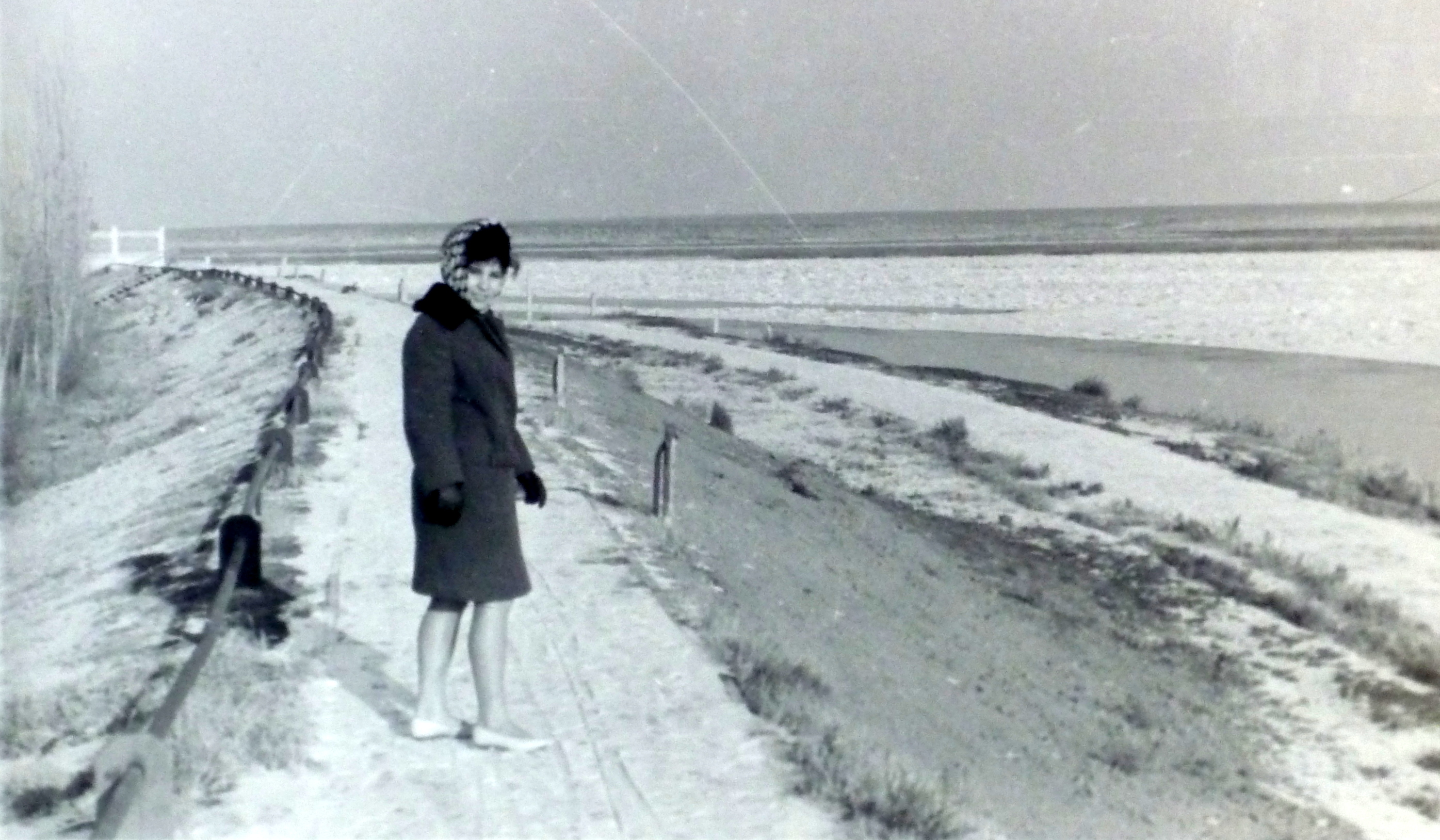
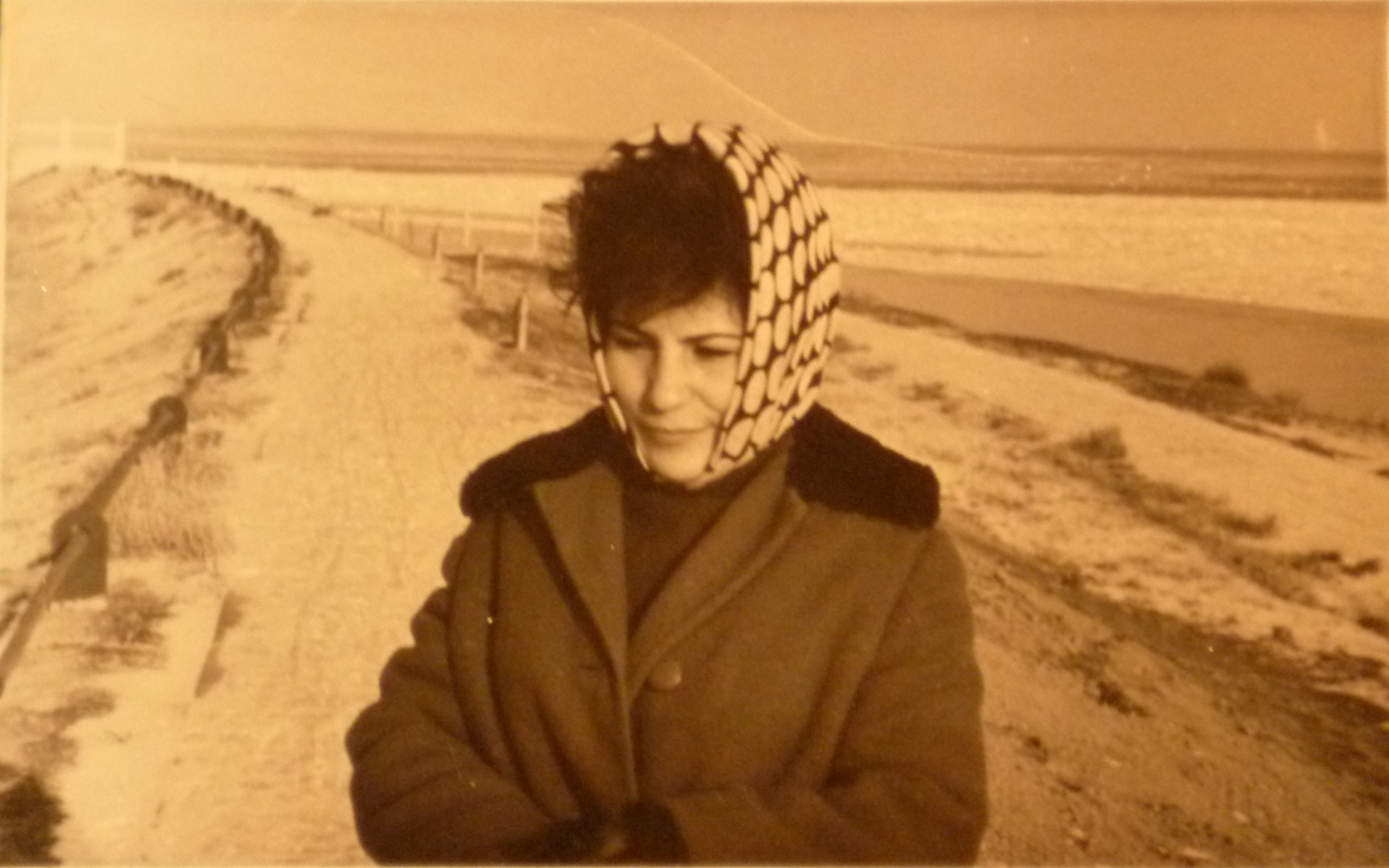
The “Zero Quarter” by the cosmonauts’ gazebo. The frozen Syr Darya. Lena shows off a lovely little coat found by chance in the children’s department of a Chimkent department store.
On 29 October 1964 we took seats in the dining car, probably ordered a full glass of tea each, and got off at Kazalinsk. We found a tiny whitewashed house and presented our request to a young Kazakh woman in the office we were looking for. She needed little persuasion: the ten-ruble note tucked into my identity card did the trick. We received the coveted stamps after paying an extra ruble and 50 kopecks—I magnanimously declined the change from three rubles. We ate a belyash apiece and returned to our site as though nothing had happened.
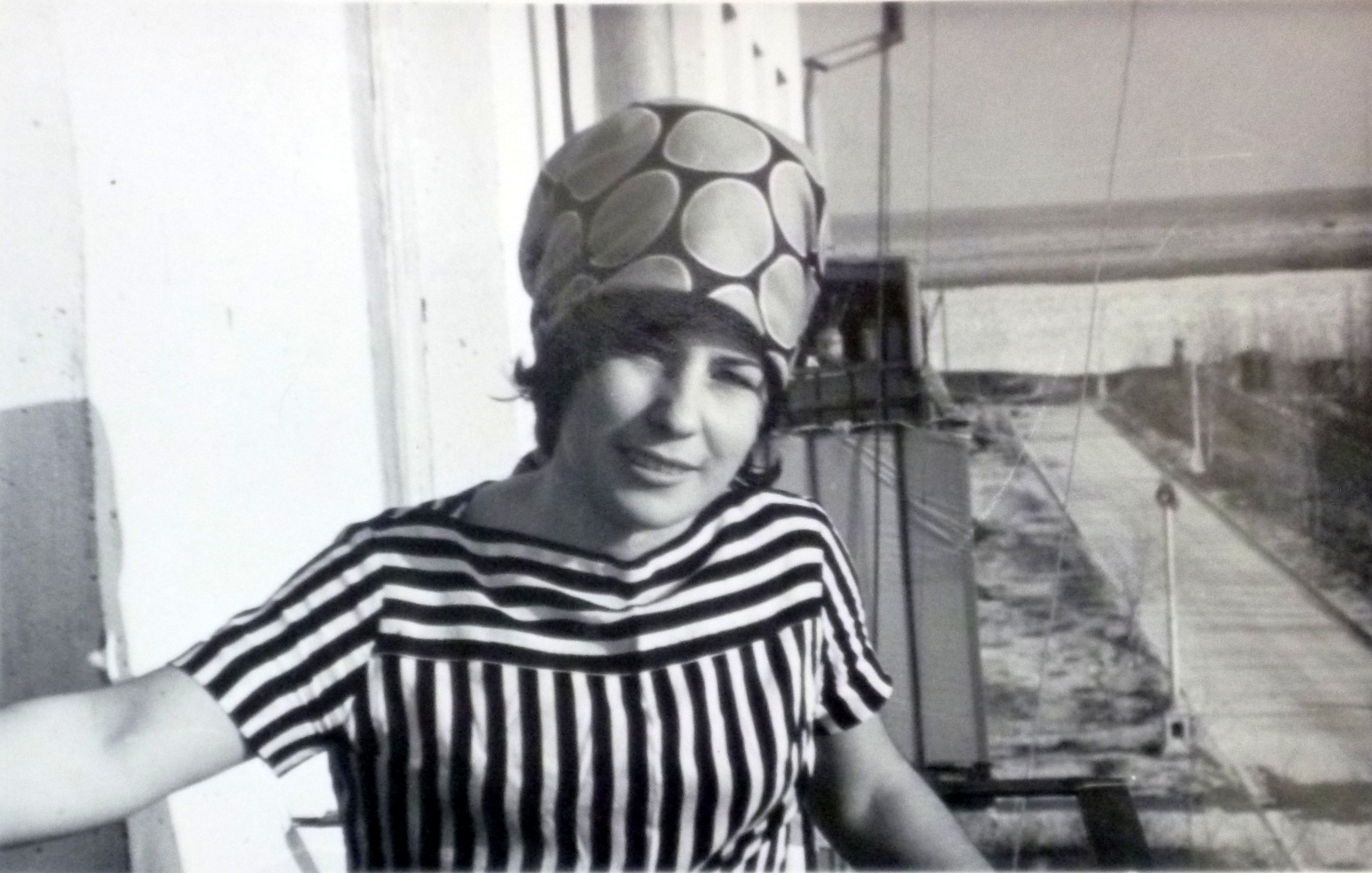
On the balcony of our apartment on Komarov Street. The frozen Syr Darya and the fence around the “Zero Quarter” can be seen behind us.
I had told none of the fellows about the wedding, but word had evidently spread through headquarters or by the barracks grapevine. Then the two of us—walking side by side rather than arm in arm, which was not our custom—went to see a film at the club. The unit’s club was enormous, the film was apparently a good one, and the hall was packed. All my friends—Vol, Lev, Farid, and Geshka Pavlov—were sitting beside the wide central aisle. The moment they saw us, they stopped laughing and talking. Their faces became oddly solemn and astonished. As we passed, they addressed us almost formally. Everyone felt awkward and embarrassed. Now that was a scene worthy of the cinema!
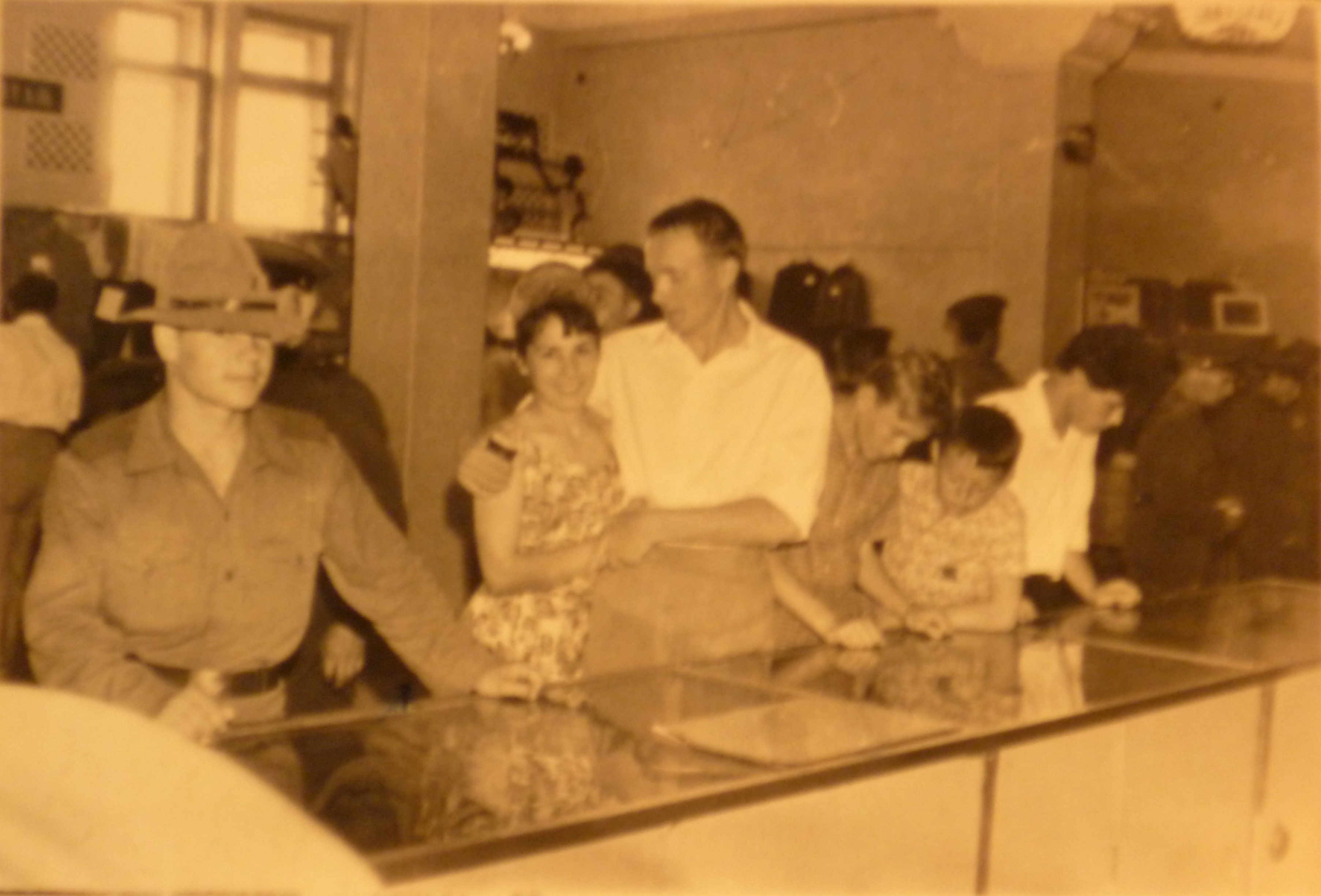
In the department store. Lyudmila Petrovna Kovriga is photographing us. 1965.
The command offered to arrange a Komsomol wedding for us, but we were utterly broke and agreed to accept only a room in a two-room apartment. The other room was occupied by the Grigorovs: Yura and “Cozibella,” whose real name was Katya. Yura was quiet, free of bad habits, and, one might say, from respectable stock. Katya was his exact opposite—flirtatious, fond of drink and cigarettes, and manager of what I think was the military shop at Site 61. One of her eyes was green and the other brown. She was generous and sometimes treated us to Czech Budvar or Prazdroj, impossibly rare luxuries. She was also excessively playful: on the very first evening we met, she grabbed me firmly by the fly and asked, “Why on earth did we get married?” Before long our new neighbors were having almost nightly battles involving edged weapons—a kitchen knife—and “special equipment”—an axe. That meant Cozibella had come home drunk. By morning they would already be cooing like doves, fully reconciled. They certainly kept us entertained.
Our final neighbor was a naval lieutenant named Vanya Iorin, a graduate of the Baku school for submarine nuclear propulsion. He was a very shy, considerate young man, but he had been unlucky with his first superior: an infantry or artillery major who bore a mysterious grudge against the entire naval fraternity. It must have run deep, judging by the zeal with which he persecuted the young naval officers. Perhaps their elegant black-and-white uniforms annoyed him; against the dusty steppe and our mass of green uniforms, the sailors certainly cut an impressive figure. Vanya came to unburden himself to me almost every evening. The major, he complained, was forever coming out with nonsensical sayings: “A bare backside flashed, and the ocean fell silent,” or “Black men die alone.” His favorite was the obscene line, “I screwed your boat that carries shit to Turkey!” “What boat? What shit? What has Turkey got to do with it?” Vanya would demand indignantly. But the worst insult was that, in front of everyone and even on parade, the major called the officers matrosy—ordinary sailors. “We are not matrosy. We are moryaki—seamen!” I comforted him as best I could; after all, I was the older man.
Gena Domontovich sold us a three-section wall unit with a writing desk and a fold-out sofa.2 Our room also contained a Festival radio and an Astra-2 tape recorder, two large homemade loudspeakers covered in green lining fabric, and books—but not a spoon, fork, or plate. It was an ordinary Khrushchev-era five-story block, and our top-floor windows overlooked the “Zero Quarter,” where cosmonauts and distinguished visitors stayed. The quarter consisted of two two-story houses on the bank of the Syr Darya. Our street was called Centralnaya even though it lay at the very edge of town: beyond it was a large park, with an irrigation pipe running to every tree, and beyond the park flowed the great Kazakh river. After cosmonaut Komarov’s death, the street was renamed in his honor.
Just before New Year 65, the unit received a telegram summoning me to 28 Petrovka Street in Moscow. I was duly sent on official travel. Investigator Maksimov met me, led me into the famous police headquarters, and explained my good fortune. Petrovka was investigating a major textile-theft case, and during a search of one criminal hideout the police had found our possessions and tires. The thieves had apparently stripped the car opportunistically—or simply from greed—while on their way elsewhere, then dumped everything at the hideout where it was later discovered. I now had to identify the property formally before it could be returned. The investigators recorded my descriptions of the missing items, then, in the presence of two witnesses brought in from neighboring offices, handed them back to me. I wired the wheels together, tied the rest into two large bundles, hurried to the station, and traveled first to Melekess and then to Tyuratam. Six months later I was summoned to testify in “the case of Avdeev and others.” I explained the situation to our chief of staff, who telegraphed Petrovka to say that I was away on assignment.
Near the hotel «Central». Lyudmila is photographing. On the right in the photo is the Shershavyy couple. I am posing in the center.
Footnotes
-
In 1956, at the initiative of I. V. Kurchatov, the Research Institute of Atomic Reactors—now the Lenin Research Institute of Atomic Reactors, or NIIAR—was founded in Melekess (present-day Dimitrovgrad), Ulyanovsk Region. It is one of Russia’s largest nuclear research centers.
↩ -
The sofa served us faithfully only until our first leave. We left Vol the key to the apartment, and after he had enjoyed a spell of “bachelor life” there with several women, we returned to find the sofa-bed resting not on its legs but on stacks of books.
↩