Chapter 8 of 29
Noxious Gases
And before the New Year, my service at the site took a sudden zigzag. I dutifully went to the secret library to study my system, but one day the deputy chief of staff, Major Timofeyev, nicknamed “Goat,” unexpectedly summoned me. He had a booming voice, truly booming: “Comrade Lieutenant, tomorrow you are taking over as shift chief at the oxygen plant.” I automatically answered “Yes, sir”—my academy training showing—but still asked what that meant. Goat named the unit I was to report to and explained why. Apparently, someone among the oxygen men had fallen seriously ill, some instrumentation technician, and I had to replace him temporarily. Shocked by such an order and completely stunned, I babbled something about knowing nothing about oxygen, and he cut me off: “They’ll teach you there.”
In the morning I crossed the builders’ territory, passed the concrete plant, and out in the steppe discovered several railway sidings crammed with trains resembling armoured trains, working noisily amid smoke and white steam. The main rolling stock consisted of large four-axle green cars, one and a half times taller than a passenger car, numbering about ten. In professional slang, “elephants.” This was the mobile oxygen plant, with railway storage facilities for oxygen and nitrogen. That was the storage facility to which I had been assigned. Liquid oxygen is kept in large tank-thermoses, and since it cannot be sealed up—it evaporates continuously—the oxygen that has already turned into gas is converted back into liquid. That is what the ZhK complex, the railway storage facility, does. The complex includes a tank car with diesel fuel, a diesel railcar, a power station, a compressor car, a process car, a control car, and a long tail of “elephants.”
Senior Lieutenant Nikolai Namis took me through the cars, trying to explain what was what. The effect was zero. My very first steps into the process car put me into a state of shock, and I never came out of it until evening. Above my head, to the right, to the left—everywhere, it seemed—were thermometers and pressure gauges, all intertwined with thin pipelines and wires; everything shook, smacked, and hummed. The iron floor vibrated beneath my feet, and worst of all was the obvious sensation of high temperature, along with the less obvious one of extremely high pressure and air saturated with oxygen. Each car held two or three sergeants, none of them young, with Kolya shouting something into their ears. Then the end of the working day arrived, and the ZhK officers, led by their chief, Major Sotsenko, began gathering for the motor locomotive. A careless briefing on the way: “Don’t interfere with the process; the soldiers are all specialists…” In other words, don’t touch anything with your hands! I was left alone in the control car, which was practically a compartment car, and naturally became bored. I walked through the cars a couple of times, very slowly and silently, both from fear and for the sake of dignity, so as not to blurt out anything foolish, and then back to the saving compartment…
The wondrous starry Tyuratam night descended, and to the monotonous rumble of the expander1 and the diesel railcar I fell asleep. I woke around two in the morning and was horrified to feel silence. Absolute, frightening silence. I leapt out of the car—good heavens, the complex was silent; the standby green lights were glowing in every car, while from every “elephant” in the entire train, steam was pouring with a faint whistle into that very wondrous night! Practically like from a steam locomotive chimney, only sideways. The continuous whistling made me feel even worse. My gut told me something was wrong. I had to investigate… In every car I found “specialists” asleep on the metal floor. It was less hot for those bastards to sleep that way. I woke the senior shift sergeant, Shcherbak, but the scoundrel merely raised his head and said it was a technological break and that by morning, when the chiefs arrived, they would start up again. And the things whistling and escaping into the atmosphere were “harmful gases.” Somewhat reassured, I returned to the compartment with my still-intelligent expression. I sat there. Waited for dawn. Worried. Sure enough, an hour before the officers arrived, the diesel started, the compressor car began rumbling, followed by the process car and everything else, and the whistling stopped…
The crew arrived and good-naturedly laughed at the “harmful gases.” It turned out that it was that very valuable oxygen and nitrogen, whose preservation the entire ZhK complex worked so hard to ensure, escaping into the wind! You can’t lock it in a tank without supercooling it. And this was just ordinary soldiers’ corner-cutting. Interestingly, I felt no resentment or bitterness toward the sergeant. They had been drafted from civilian life as specialists, and were older than me…
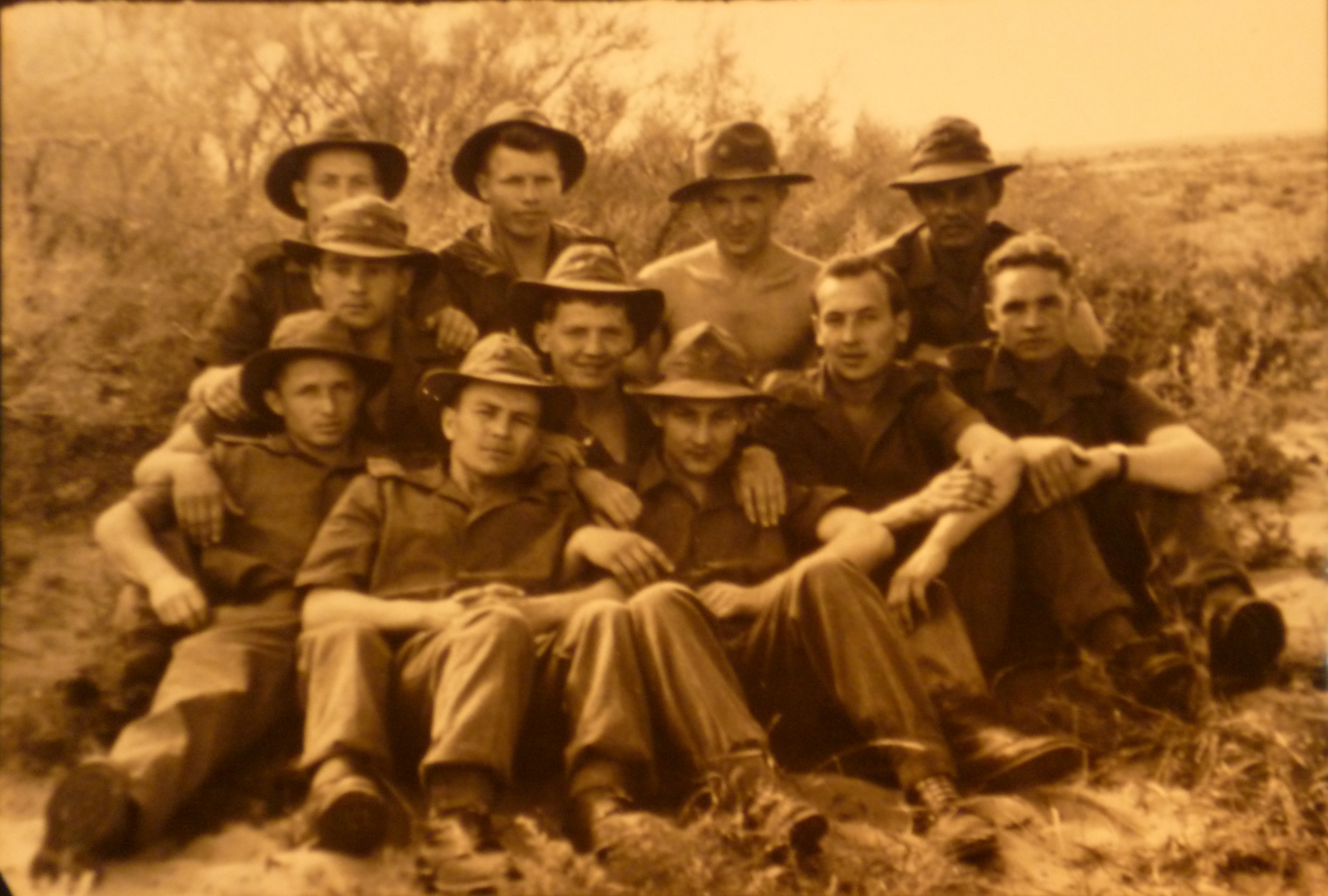
The “shift chief” and his subordinates. On the left in the photo, to my right (the big fellow), is Sergeant Shcherbak. Sadly, I forgot his first name.
That was how I began to find my feet. After a shift I carried a bucketful of oxygen or air to the hotel to make ice cream or simply chill water. The bucket, of course, was not full, so I would not spill it on the way. In appearance, liquid air looks exactly like water, only with a faint mist above the surface. It is noticeably lighter than water by weight. Oxygen behaves the same way in a bucket, only it is slightly bluish.
At the hotel, a soldier’s field thermos awaits, filled with several cans of condensed milk dissolved in water. Its useful capacity is 10-15 litres. The most important thing is to have a sufficiently long wooden stick ready for stirring. We pour in air or oxygen and stir extremely vigorously. The temperature of each is minus 190 and 183 respectively. The main thing is not to let the upper layers of the mixture freeze first, so you must pour very sparingly. But no matter how quickly you turn the stick, it suddenly freezes into the ice in the most unexpected position. That’s it, the session is over. And there is still so much air or oxygen left! If you pour the leftovers into the thermos, you can disperse to the rooms along with the prepared cups and mugs. There will be no movie for another hour or more. The most desperate try pouring warm water onto the ice and, before it freezes, manage to scoop up at least a drop of cold water. But the ice immediately keeps growing, and growing, until there is nowhere left to pour the water. Kvass was frozen in the same way. The leftover liquid gases went into experiments freezing insects and plastics. Everything froze instantly with a faint snap and became extraordinarily brittle and fragile, lizards included. Once I walked across sand frozen by spilled oxygen, and that was the end of my boots: the sole of one of them almost crumbled away.
In addition to regular duties, I was recruited for the operation of washing the “elephants.” But only as a substitute for the regular washer, Namis. This was a dangerous operation for two reasons. First, inside the tank a soldier worked with rags, scrubbing supposedly perfectly clean aluminium free of oil and other deposits, while above him an officer actively poured alcohol from yet another canister. The soldier wore a gas mask and breathed clean air through joined hoses led outside. Kolya Namis literally sat at the end of this hose. If the supply of outside air stopped and the soldier inhaled alcohol vapour, suffocation was inevitable. But the officer had an equally important task: preventing the flasks of alcohol from being thrown out, for they would fly in a fan from the hatch if he happened to doze off. That was the second danger of the operation. The soldier always stocked up on empty flasks while climbing into the tank. And outside, beside the tank, someone from the off-duty shift would be hanging around, waiting for his chance.
At the appointed hour, someone from FKhL (the physical-chemical laboratory) would arrive with their special wipes, climb into the tank, and start nitpicking. I most often saw Senior Lieutenant Pasha Yarandaikin doing this.
Winters in the Kzyl-Ordinskaya Region are light on snow, but strong winds blow often. At minus 20-25 degrees, it is something else. I remembered the Irkutsk winters as blessed. There, the colder it is, the quieter the winds, and the clothing is completely different too. At the academy, for winter they issued two sets of underwear—thin and insulated. Here there was only a little greatcoat lined with fish fur. A bitter cold such as I had experienced neither in Krasnoyarsk nor in Irkutsk. There were also perfectly comfortable winter days. Snowy winters did occur, but rarely and not for long. In seven years I remember only one snowy winter. We decided to play football then, with spectators too. We dressed in field uniforms and boots. Dense snow came up to our knees. The game, played to the cheers of the supporters, turned out to be wildly exciting. By the end of the match our leather boots had completely gone soggy, becoming like rags.
Time was racing toward 23 February, and I decided on a serious purchase: I went to our regional capital, “Kzyl-Paris,” and bought a “Festival” and a small suitcase of the local vodka, arak. Arak is Kazakh vodka. The train to Orda takes four hours. And the receiver comes in a huge casing and is even supplied with a remote control. Nevertheless, I successfully hauled it all to the site and gathered the team in my room for a modest dinner. Well, when kindred spirits and loyal friends and comrades are sitting around the table, what brakes could there be? And besides, this was still my first birthday in my first unit. Until I blacked out, I remained in a state of intoxicating “calf-like rapture.” A lieutenant—a rookie! For some reason, the art of drinking sensibly did not come to me at once; it arrived with the years. We stayed up late, so late that in the morning the deputy political officer, Lieutenant Colonel Fedorenko, and someone else came to visit me personally, naturally for educational purposes. Apparently, drunkenness was a bad thing—but why, then, had I also run naked around the hotel on a dare? I remember many things from those years in detail, but of that morning I remember sitting on the bed while this priest was lecturing me about something, and I remembered nothing; I had no past that morning. We had dined well, but the arak was vile. And in general, arak must not be mixed with spirits!
* * *
Spring came, the steppe turned green, and perhaps the steppe tulips bloomed too—I don’t remember. They do not bloom every year. But when they do happen to bloom, the whole dreary grey-yellow-brown steppe transforms within a few days into a bright flowering red-and-yellow carpet. Not for long, just a week or two. On such days, almost every passenger on the motor locomotive gets off in town carrying a bouquet of tulips. Just as quickly and unexpectedly, the flowers all wilt, and the steppe takes on its standard colouring again. In April I travelled in a special car, the ZhK control car, escorting this car with two sergeants to Alma-Ata. The car had four compartments, a shower, and a toilet, and from the outside looked like a passenger car. They coupled it to a freight train, and we set off for scheduled repairs in Alma-Ata. We travelled slowly, but in comfort. Alma-Ata is a very beautiful city, but my money ran out unexpectedly quickly, so I sent a panic telegram to the unit, and Vol Ambrosovich promptly bailed me out with a transfer. And money flies like the wind on your first-ever business trip. Must you go to a restaurant? Must you treat your loyal sergeants to something tasty? You must! And a girl somehow appeared on her own.
I drifted through that completely unstrenuous assignment during the flowering of the city’s apple orchards and returned home almost a month later. By then the combined team had begun preparing for the Rocket Forces championship in Kirov, formerly Vyatka. On the way to Kirov we stopped in Moscow to train with the MAI team. We stayed in some institute dormitory. Sasha Zhmakin’s former classmates put us up. We played the students for practice and headed on to Kirov. We performed fairly well in Kirov, not among the last. Our goalkeeper, Lev Kostyuk, was taken onto the Rocket Forces team! The return journey was also up to standard—we had such a good time sitting in “Prague,” eating cold vodka with chops on the bone and washing them down with beer in a cosy restaurant booth, that I left my dress tunic there. Thank God, without my documents. I woke late, already during the day, blinded by the sun, lying on my back on the lower berth, fully dressed and wearing my boots, but with my feet on the floor. Very civilized. That was how I made it back to the unit without my tunic.
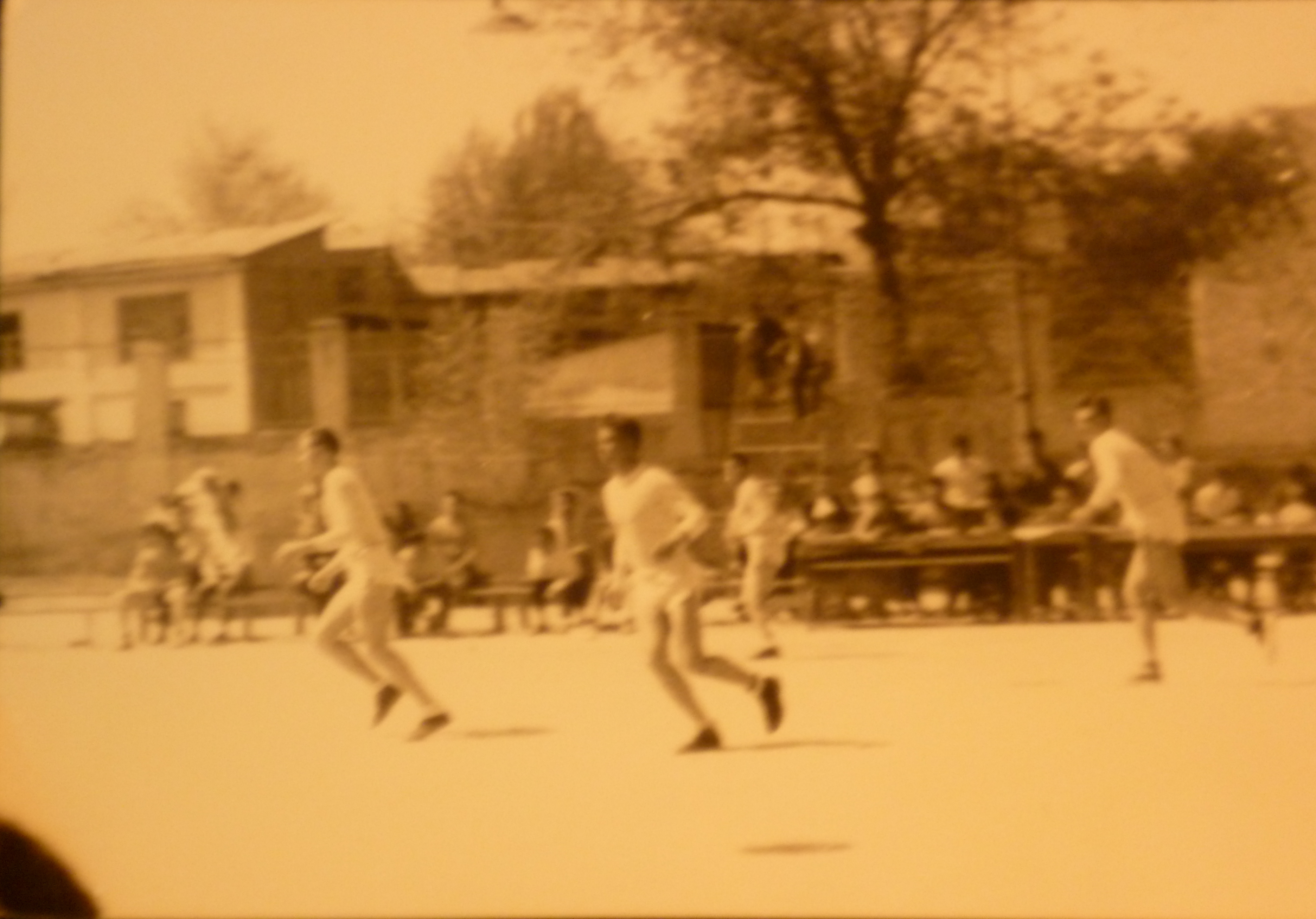
Tashkent. The Tyuratam team attacks. Sasha Zhmakin in the centre, Kolya Chernyshov behind him, Yura Nemykin on the far right (our finisher), and on the left in the photo, running, is me.
And here we are home, at our 32nd site. Military workaday life, brightened by nighttime listening to music broadcasts through a wonderful radio receiver and rare trips to the “Ten,” mainly for dancing, at the Officers’ House. And how do you get there? The most convenient and reliable transport at the test site is, of course, the motor locomotive.
Footnotes
-
An expander is a reciprocating or turbine machine for cooling gas by expanding it while performing external work. The ZhK complex used reciprocating expanders.
↩