Chapter 10 of 29
Akim-Bolt
In our dormitory there were only officers—bachelors from the second group, the group of horizontal (autonomous and integrated) tests. About 30 residents. The crowd was mixed, from reclusive intellectual hermits to desperate revelers. But all relationships, the very air of the dormitory itself, was saturated with responsibility and the friendship of men, welded together not by fake political-officer slogans, but by common serious work. And since 90 percent of the officers in the group were young men, there was constant music in the dormitory, someone laughed out loud or an entire room burst out laughing, billiard balls were knocked, or at the end of the corridor some pair, putting on gloves, boxed in front of one or two spectators.
Three of us lived in the room: me, Lieutenant Vadim Filippov, party nickname “Baron” (he seemed to be a real gypsy), and Captain Kolya, whose surname I do not remember, but whose nickname was “Malets.” Very quiet and kind, and very short. We lived very well together, the captain had a room on the “ten” and did not come over to stay often. But once he did not go into town and stayed the next night, and literally the air in the room smelled of pure kerosene. I understood nothing, and Baron figured it out: it was our Malets secretly coating his rear and his belongings with kerosene at night. He had recently returned from a trip to Kuybyshev, where he had gone with the guard to the Progress plant for a rocket and had brought along, incidentally, insects from the local women there. Immediately after questioning, Malets was put on the bed, tied up with towels by the hands, and more or less seriously smacked. He shouted loudly, but not viciously. They repeated it the next day. But he was an excellent comrade. It is a pity he soon died stupidly under a truck’s wheels—he was making for the city at night by rides, running a poll at the intersection by the second checkpoint; the first car dazzled him, he took one extra step, and the second one took him.
Good old life takes its due, and when on weekends men like Misha Podpalov, for a valid reason, remain in or are delayed in the dormitory, there is a huge circus. At the height of drinking Misha would always dance with the wardrobe. A standard wardrobe, a Ketchovsky three-door one, which two people could not lift. But not for Misha. Strong as hell! Medium height, but broad in build and a very full face. A lover of drinking and lewd joking. I can’t tell you about lovers of seki and preference; I did not play. Although, indirectly, I participated as a sponsor. If the card players knew I had money, then on a night of play, even if you locked yourself in with a key, they would ask for a loan when losing. Some blew through 2 or even 3 wages in one night, and they were fed for free.
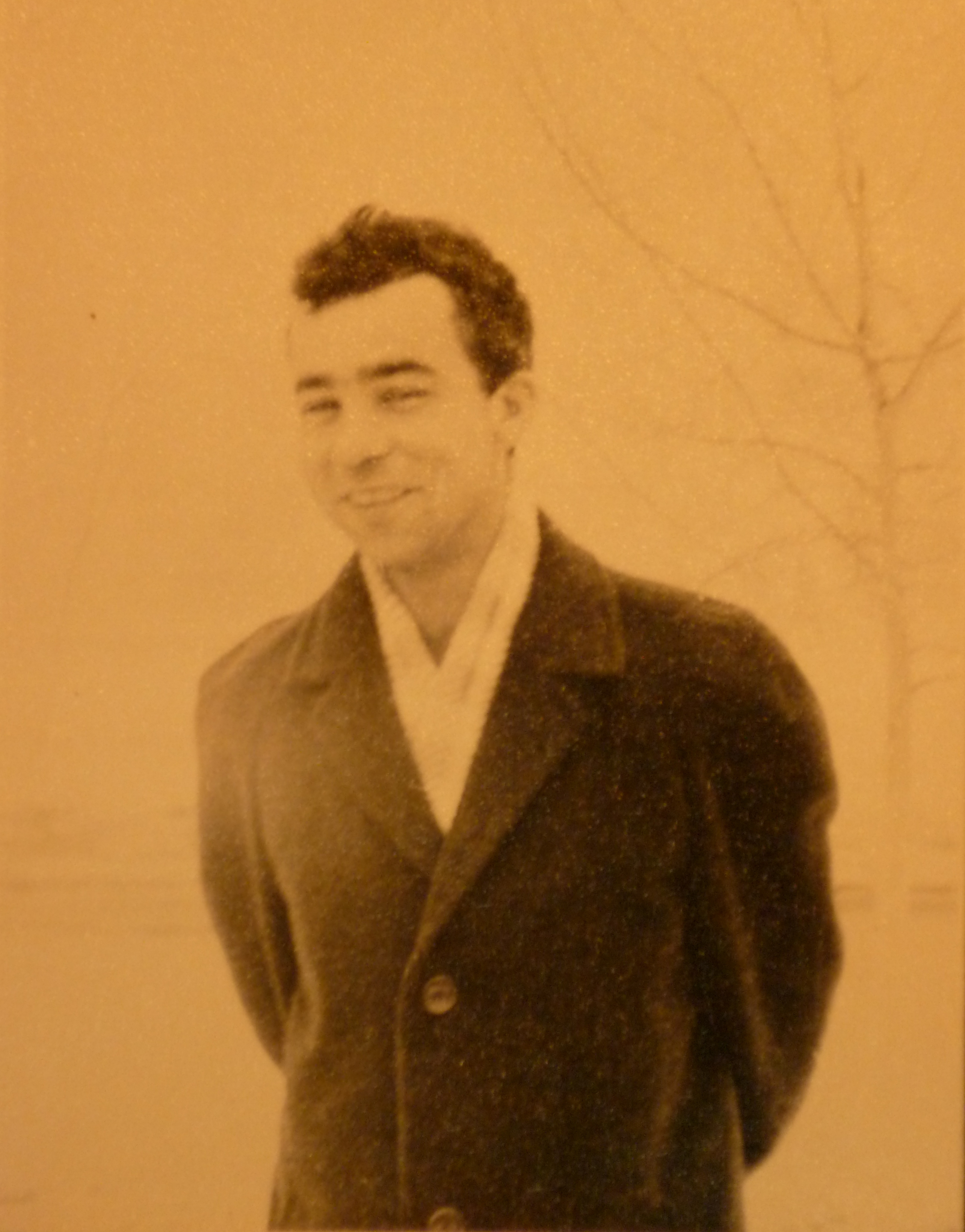
And this is our “Fara”.
Only Farid Mukhammedov never lost at seki. He was the most talented person in many things, not only in games. Fara kept a secret notebook (from the command) where his debtors were listed. Once he showed me some page with abbreviations and numbers and said: “and this one will be a television for mom.” In these battles for 21 points, Fara represented the radio-control point with honor. (I wrote it down—radio control—and again remembered the wonderful days in the company of Ambra-Sukha.) I remember Alyik Kostikov, also an ardent card player, who taught me how to drink properly, with a “podkladka.” That is when you take the first sip of cold water, but you do not swallow it, you hold it in your mouth. Then calmly drink a shot of alcohol, without suffering, finishing it with good gulps of water from the pitcher or mug. Without hurrying, Alyunya carried out the whole ritual of preparation for the drinking rite, carefully, without haste, cutting lard into very thin slices and placing it on bread. He arranged pieces of bread on a plate, and did not pour water into vulgar glasses but into tiny shot glasses. Then came the main process…
Later, fate—or more precisely, a unit order—joined me with Gena Domantovich. As an officer of the radio-control point, Gena lived in a two-story dormitory and kept rather independently; he had not been seen in happy crowds, i.e., in the mornings he did not drink cold water but took his mandatory run around the area in wonderful light-blue tracksuit.1 By order from the unit I was assigned to a support group for party state control or something similar, equally absurd in name. Captain Vasiliy Vasilyevich Savinsky headed the group. So together with Gena we counted piglets in the piggery, cans in the warehouse and reweighed butter in the canteen. And everything happened always suddenly. So they remained forever non-party. And we still meet for many years now at Gennadiy’s apartment in Moscow as a trio of “refractories,” Lev Kostyuk, Gena and me.
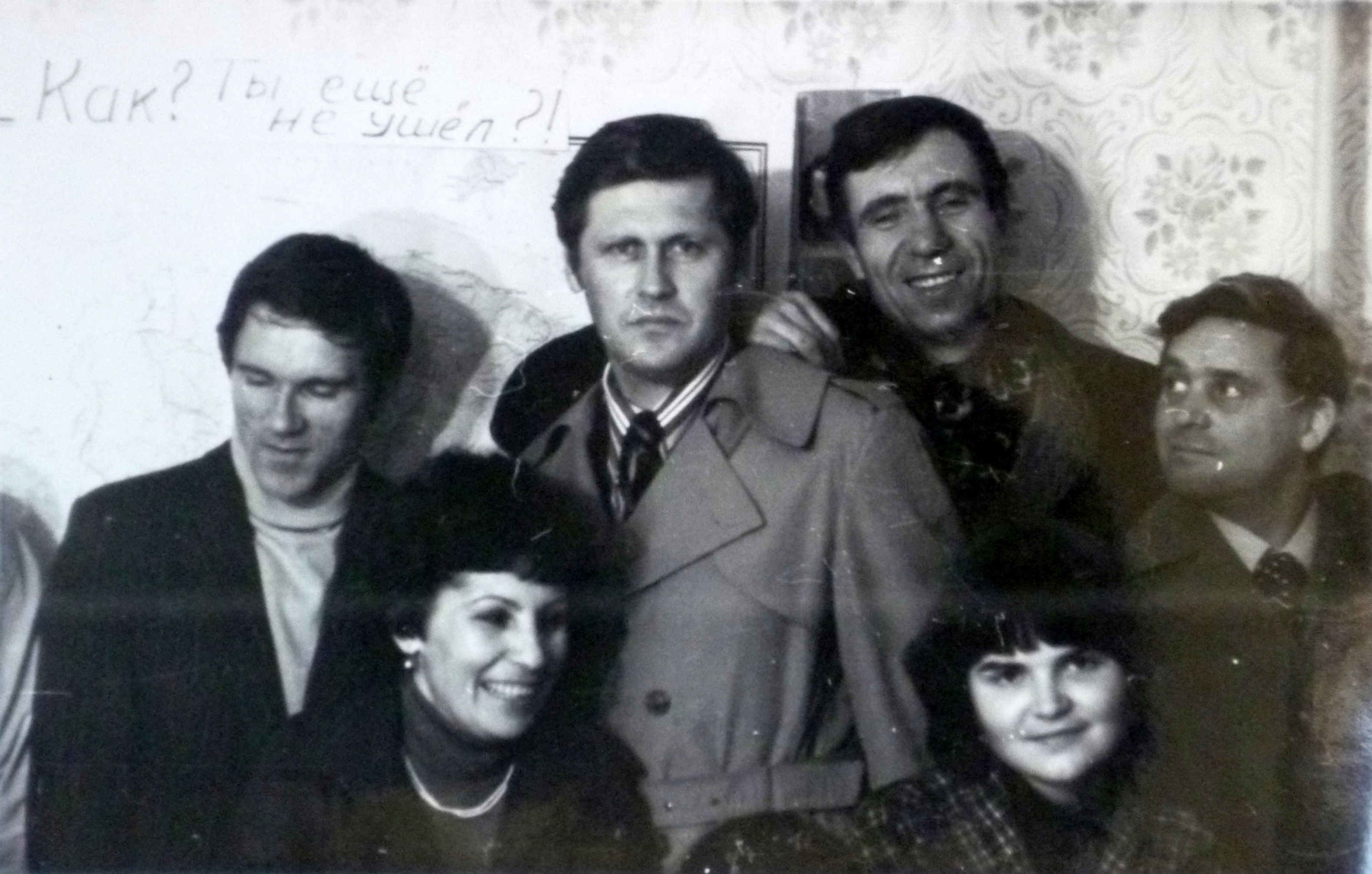
Lev, Vanya Solntsev, Vitya Sysovey. I had already partly forgotten the fourth. (at Gennady’s apartment). And Lena Mesheryakova laughs the loudest.
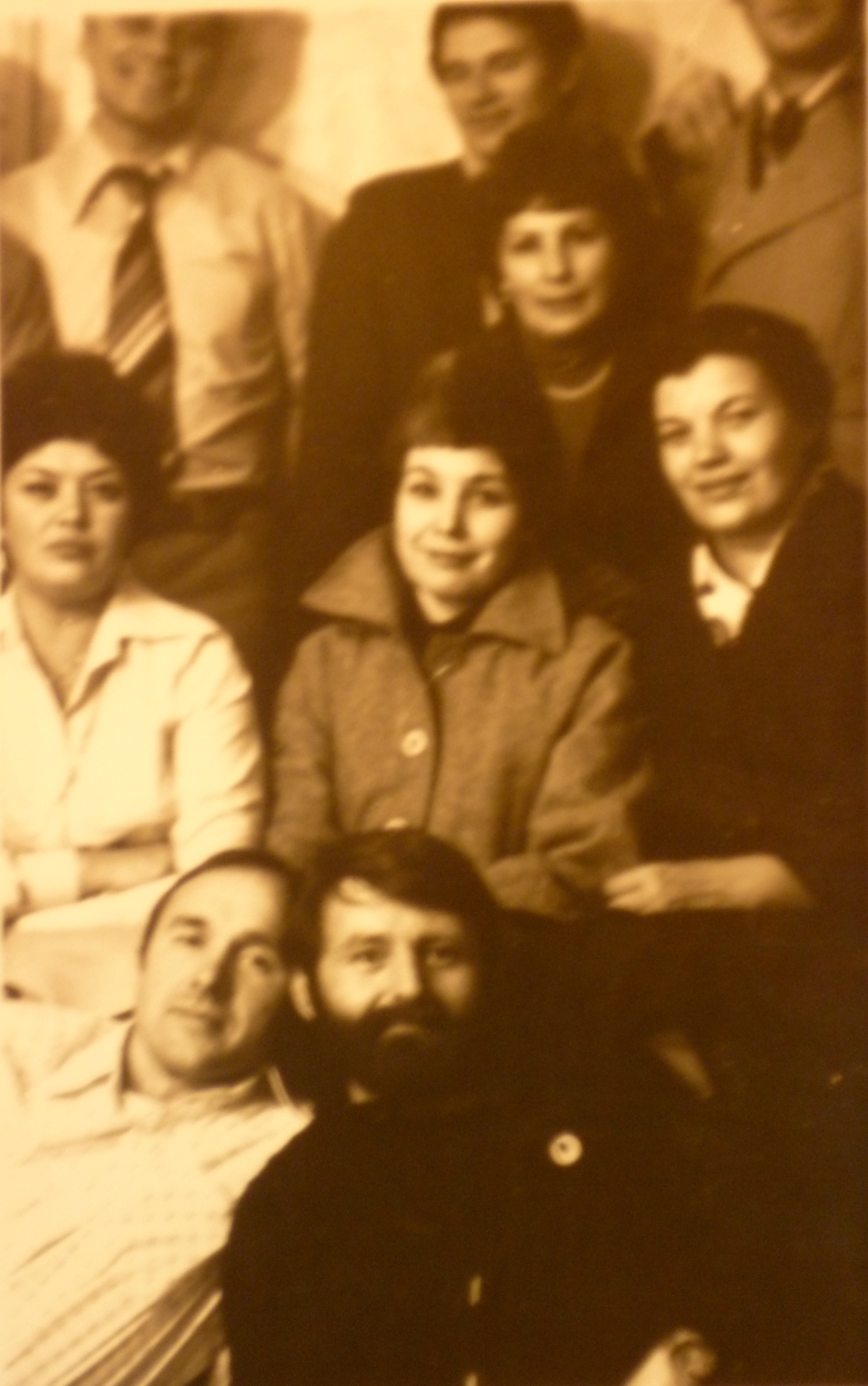
One of the Turatamtsy meetings at Gennady’s apartment. At the top: Shershen, Lev Kostyuk and Vanya Solntsev. Below: Lyusya Shershavaya, Sveta Solntseva, Lena Mesheryakova and Galya Sysaya. On the floor: me and Gena. Vitya Sysov and Tanya Kostyuk are not visible.
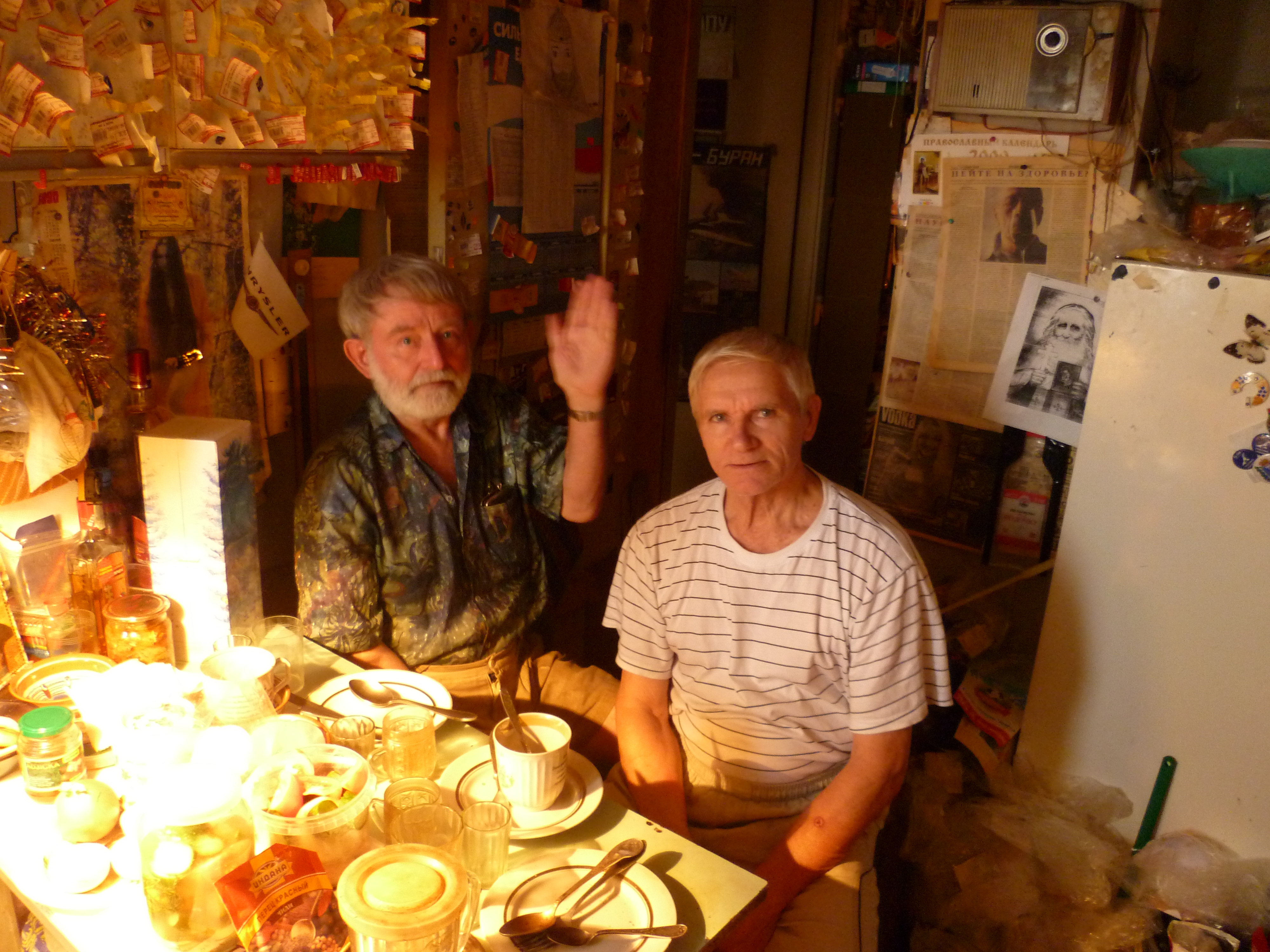
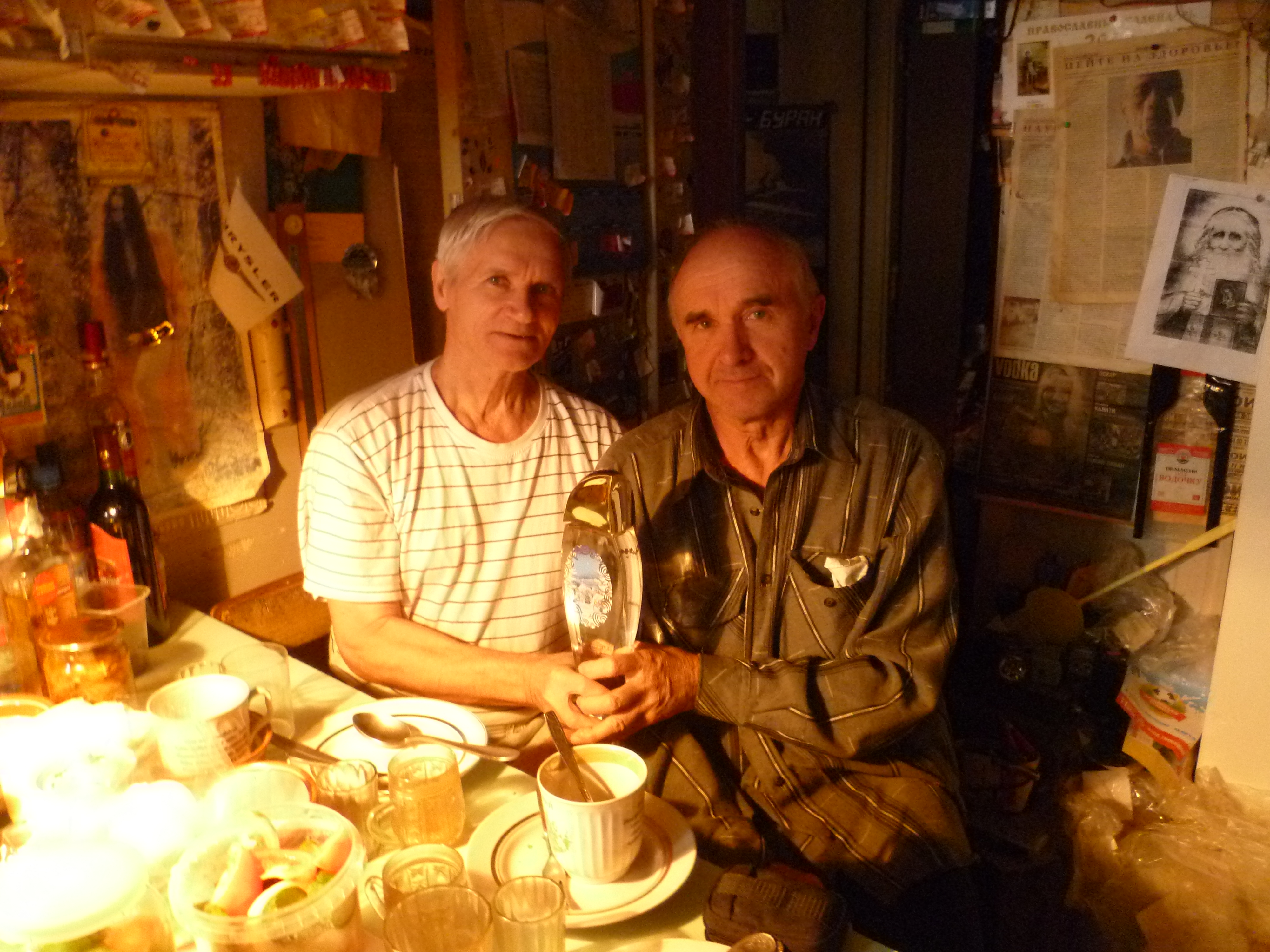
2011, the same apartment, but graying, balding, and with another interior. The owner of the apartment is convinced that one can live fine anyway.
The most interesting and for most attractive room in the one-story dormitory was occupied by Dima Tropinin, also “Tropinin,” and Slava Akimov, also “Bolt,” “Boltyara,” “Sherushilka,” “Kolotukha,” “Anaconda,” “Samets,” “Zadvigaylo,” “Giant,” and this is not the full list of his nicknames. Later, Tolya Korneenko, also “Ugol,” moved into this room. A frequent and welcome guest of the room was Albert Nikolayevich Kovriga, head of Dimentiya and Tolya, a captain from the navy, graduate of Peter’s VVMURE. He was an excellent comrade and a peerless teller of anecdotes.
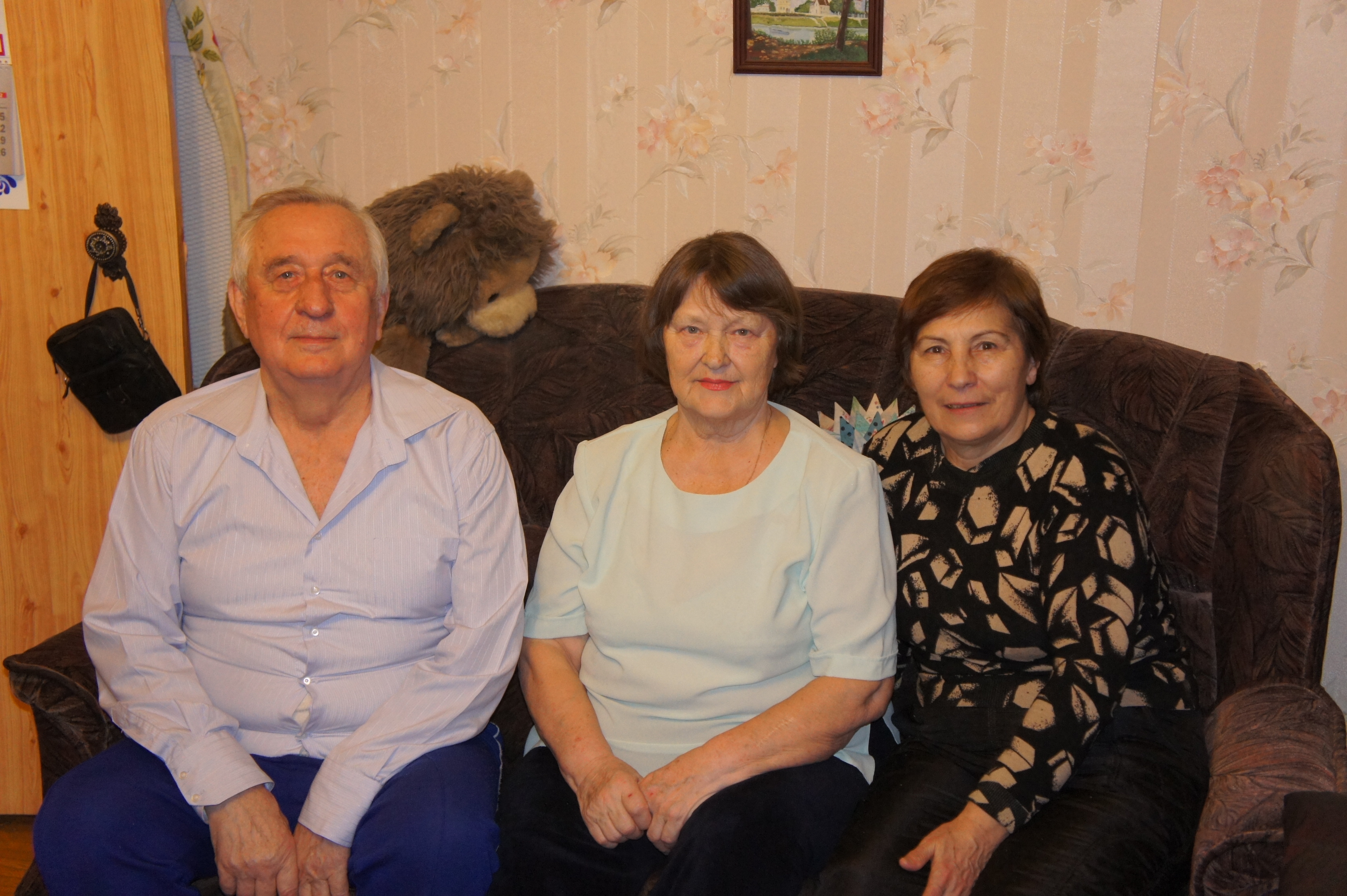
At Luda’s and Albert’s, February 2012.
All of them were preparing the onboard radio equipment of the rocket at MIC. Slava worked with NS, BS and RCS equipment. Normal stabilization, lateral and regulator of apparent speed. A competent specialist, well-read, interesting interlocutor, very tactful in communication and terribly suspicious. He watched carefully and anxiously, day after day, over his health and, what especially surprised me, his mood. “My roots hurt” — his standard complaint about his hair to everyone who entered the room. As for larger organs, he knew everything. He was of medium height, broad-faced, but a great expert and an enthusiast for debates about relations between the sexes. A major specialist, but a theoretician. And he had a good friend of Akim’s (stress strictly on the first syllable), Vova Denisov, also Dennis, also the “Man with the Big Face.” He was bald, like Lenin. Dennis prepared onboard gyro-instruments during autonomous tests.
So this Denis, in order to upset Slava, once, when there was a gathering of people, praised with approval the allegedly outstanding size of Slava’s penis, and he achieved his goal. As usual Slava protested in his plaintive voice. Why, this innocent joke not only pleased everyone, but became the start of literal harassment of the poor old coot. It came to the point where any young lieutenant could walk up to Slava and, without even a tap on the shoulder, almost ask kindly: “And how is the health of our Kolotukha?” to which Slava always complained in a slightly nasally whine: “What’s wrong with you?” which only provoked the whole group more.
And here our splendid political organs are creating an Avenue of Honor and decided to place it behind the Officers’ House, where there is a very large area with flowerbeds of beautiful flowers and asphalted paths. So along these paths they placed large portraits of forerunners, painted well, set in metal frames on high stands. Literally on the second day, beneath Slava’s portrait, a gigantic bolt hung on wire. To everyone’s joy.
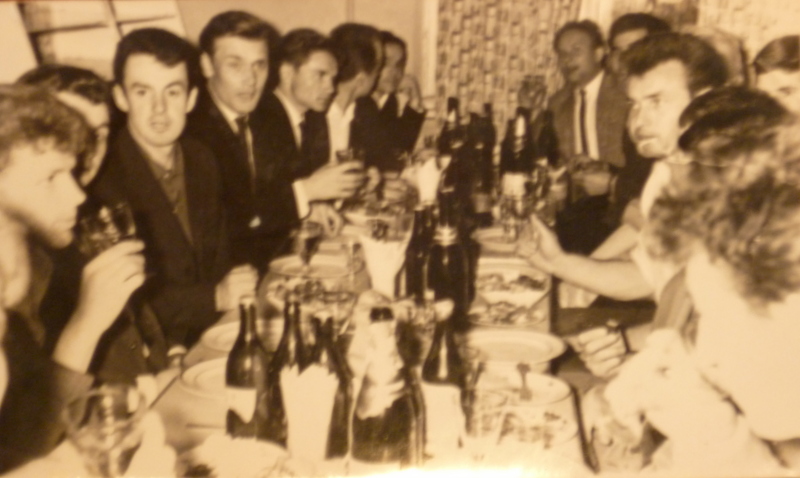
Third from the left, in front view, Slava Akimov. Behind him are Yura Nemykin, Lev Kostyuk, Dima Tropin and Kolya “Malets.” At Shershny’s wedding.
And the story that immediately became everyone’s property—the morning routine of Tolya Korneenko in Akim’s room on the “ten”?
Slava, as a frontrunner, got a room in a multi-family building on the first floor and to his misfortune allowed Tolya, our hussar and seducer, to sleep on the floor. Nothing special, a normal bachelor Sunday situation. But the consequences were terrible. In addition to Tolya climbing into the room through the window at night with a terrible noise, dropping onto the floor a 20-kilogram weight that supported the sash, he allowed himself in the morning, when the whole apartment gathered for the outing, to “let out the wind” louder than orchestral brass. In true hussar style. In a semi-faint state, Akim falls onto the bunk and, gripping his head, groans: “How can I leave the room now? There are people in there!”
In the spring of ’63 we three, Tropin, Akimov and I, came to the “ten” and bought ourselves HVZ “Turist” bicycles, so-called light-road type. We tuned them over, serviced them, and started riding within the 32nd and nearby. I immediately decided to head to the “ten” on my own wheels on the next day off. It was all right, mainly you had to leave early, before the heat, and so there was no wind. My record 1 hour 47 minutes. There were unsuccessful expeditions too; I returned because of a strong headwind. I got overheated—too late departure and due to the heat, I rode slowly, about four hours. And once I figured out while on the road to test my vestibular apparatus, so to speak, for road stability. How long can one ride with closed eyes? I was just tired of driving my phalanges on a lot of morning asphalt I’d climbed. I began the experiment with short intervals, liked it. I lengthened intervals until, at full speed, I rolled down an embankment in a tumble. As if on purpose, there was a ditch at that place. And my clean and greased bicycle, together with the saddle, got buried in the sand. Fool! But in general, a bicycle is a really useful thing; it varies life. It was later used in the process of wooing a future wife.
The sixties came, and in the Union some thaw was under way; people greedily read One Day in the Life of Ivan Denisovich, a miracle and courage by Alexander Tvardovsky that came into the world, and listened to Bulat Okudzhava singing. Since through all my school years, without exception, I lived behind barbed wire, where my father worked in secret cities of the Ministry of Medium Machine Building, and there in the first years massive slave labor of prisoners was used, I often saw those dark faces in thousands of people in guarded columns with red-cheeked soldiers and shepherd dogs. And reading the novella revived my mother’s pity for the unhappy, how she used to send me to the construction of a housing building to bring bread and sausage to the prisoners. (This was in ’49 or ’50 in Chelyabinsk-40.) Now I think I know, I hope I know, the scale of repressions, but even now I do not understand the emergence then, in those years, of any expectation of a new, more open life, some changes after reading a completely harmless novella in another issue of Roman-gazeta. And in general one should thank fate for throwing me onto the test range, the forefront of science, with its natural democracy and humanity of relations, instead of some ordinary unit.
Footnotes
-
Independent, occupied, and even seemed stiffly proper. Now he is the most hospitable, drink-serving host of “malyina” on Chelyuskintsev Street, where regular gatherings of “non-party scoundrels” take place.
↩