Chapter 15 of 29
Showmanship and December 14
The year 1966 had begun. At the start of summer, strange things began happening in the town. Communal workers started going from apartment to apartment, reglazing windows and replacing even panes with the slightest cracks. All balcony railings were clad in thick reinforced glass. The town’s buildings were painted in beautiful, varied pastel colors. Tall concrete poles with powerful lamps were installed along every road (such things had only just begun appearing in Moscow). And the roads in the town—and, most astonishingly, throughout the entire launch range, which stretched for more than a hundred kilometers—were covered with superb asphalt. On the range’s technical roads, European-style direction signs and road signs with reflective coatings were installed! And that was when we first saw the sign “Baikonur.” Before that, the newspapers had already been calling our range by this absurd name, as disinformation for the enemy. Near the crossroads leading to us and to Site 43, a large area was asphalted and a huge sun shelter erected. Halfway from Tyuratam station to “the ten,” a completely new, attractive station appeared, with a new boarding platform. And then something truly mysterious began: regular training runs of some special, outwardly passenger train along the range’s internal tracks, accompanied in parallel along the parallel road by a cavalcade of seven “Chaikas” and a brand-new, beautiful ambulance. It should be said that all the range’s railways were duplicated by roads. I once examined some details of how these carriages were built. The most remarkable thing about them was that when the vestibule doors were closed, there was nothing on the outside to grab hold of, and even the steps were covered by a solid panel.
We, the combat crew, were issued a new technical uniform, well tailored, blue in color, and a beret for our heads! Before that, everyone went around in some worn-out black one-size-fits-all robe, soaked with 88 glue, with trousers made for a fat man and tied up with wire. And on your head, whenever you left the building, you were required to wear the regulation peaked cap; now there was a light beret. Much better!
The picture became somewhat clearer when unfamiliar men in civilian clothes began visiting apartments whose windows faced the town’s main streets, advising people not to show themselves when “high-ranking guests” arrived. Lena and I lived in exactly such a room, on Tsentralnaya Street, later renamed Komarov Street. Meanwhile, the press was trumpeting the expected visit to the USSR by the President of France, Charles de Gaulle. On 25 June, everything planned and prepared for the visit went like clockwork: before his astonished eyes, they launched the satellite “Kosmos-122” from our site and carried out a silo-based intercontinental missile launch from Site 61. Eyewitnesses said that the entire French delegation was openly delighted by such an impressive demonstration. From then on, this new railway station forever acquired the unofficial name “De Gaulle Station,” while the entire operation had the official code name “Palma.”
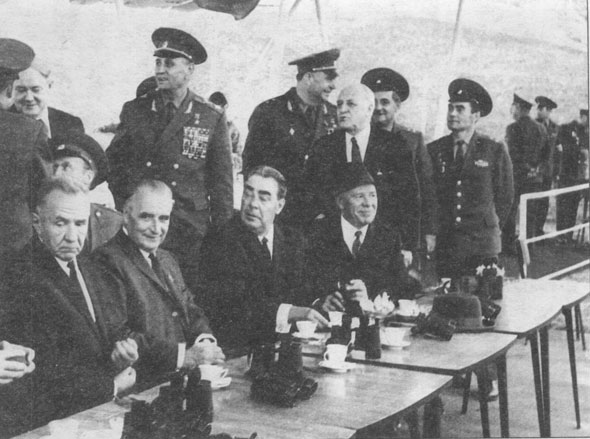
In the photograph, from left to right: Kosygin, de Gaulle, Brezhnev, Podgorny.
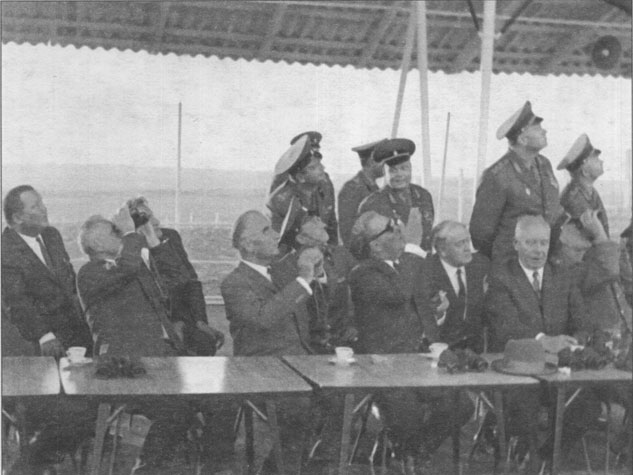
The Kremlin’s dungeon-dwellers liked this show so much that afterward there came an entire succession of visits and corresponding displays of empty spectacle. Heads of dem1. countries arrived, along with the new President of France. Accordingly, the operations demonstrating our might were called “Palma-2, 3 and 4.” The golden, stellar age of political officers and the rest of the party rabble had begun. How many orders they raked in for it! And the hard-working combat crews bore the brunt of everything.
And our Site 31 was rapidly expanding. They built a large fueling station for heavy satellites, the MIKKO, an anechoic chamber for the “Soyuz” program, a building for training canine cosmonauts, a cosmonauts’ house, and a training center. MIKKO means the assembly-and-testing building for space objects; Structure 40 was a building almost four times larger than the old MIK. The launch facility was modernized.
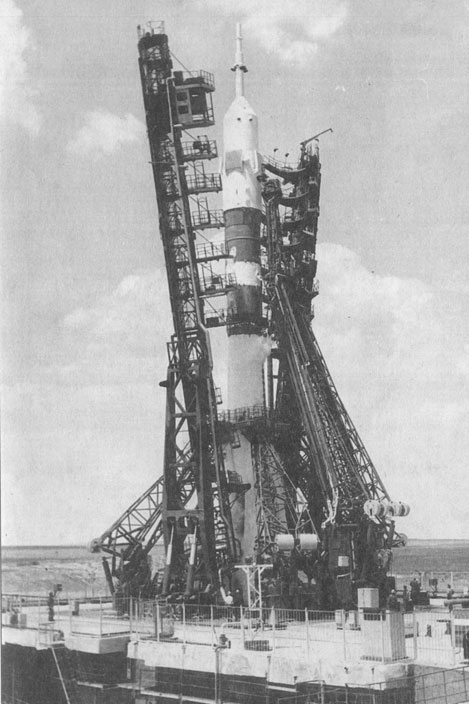
11A511U is installed at the launch facility
The year 1966 was an absolute record-breaker in the number of launches. That year, the unit’s personnel prepared and carried out 29 launches. And in the SOBIS crew at that time there were only two officers left: Valera Makhnykin and me. We had to run back and forth between the bunker and the MIK.
At the end of November 66, two launch vehicles and two spacecraft of the new “Soyuz” type were prepared, with the task of working out automatic docking in orbit. On 28 November, the first unmanned “Soyuz” (Kosmos-133) was launched. My SOBIS console was the outermost in the chain of the bunker’s main consoles, next to the television sets; one showed the launch facility and the vehicle with the spacecraft, while the other, in scanning mode, showed the interior of the descent module. I had never seen anything like it before: a mannequin sat in the DM (descent module) seat and, without blinking, stared into the TV camera. The launch went well, but the spacecraft did not stabilize in orbit and began tumbling. Nevertheless, the chief designer decided to launch the second “Soyuz” as well, to test the modernized launch facility.
In the next TASS report concerning this launch, it was briskly announced as an absolute success. TASS, generally speaking, mostly lied to its own people, or at least embellished the truth. Ten or nine attempts at a soft landing by the first lunar probe (which sent back a panorama of the Moon’s surface) were absolute failures. Either it missed, or the landing was hard. TASS always played the triumphalist, and the entire Soviet people rejoiced along with it. For as long as this Leninist government has existed—I hope, existed—the people were kept under deception. I am sure the Central Committee functionaries did not spend long pondering whether to tell half the truth or keep silent. Why stir up the little people, why introduce dangerous doubts about the infallibility of the general line toward a bright tomorrow?
On 14 December, during an attempted launch, the “ignition” command for Block “V” did not go through. An all-clear was given on every circuit, the people left the bunker, both service gantries with their lifts were raised, and approximately 27 minutes later, while the service gantries were being brought together—known to the locals as “Mashka”—the launch escape system SAS2 unexpectedly activated (because the SAS automatic gyroscope frames folded after the gyroscopes were switched off, sending an “Emergency” signal from the frames to the limit contacts). As it was supposed to, the SAS tore the spacecraft’s descent and habitation compartments away from the instrument compartment, lifted them, and lowered them by parachute beside the underground oxygen plant. The spacecraft’s thermostatic-system coolant caught fire from the pyrotechnic bolts and the powder-engine flares that fired during separation. The rocket stood there, with a bonfire burning on its crown! (For some reason I did not take part in the launch of that ill-fated spacecraft, to Lena’s delight, but I vouch for this “report.”) In short, the spacecraft’s balloon tanks ruptured, its propulsion-system fuel tanks exploded, then the tanks of Block “I”—the third stage—exploded, followed by everything else. The explosions were soft, but intensely energetic. In the end, little remained of the facility. The people naturally renamed the Emergency Rescue System the Start Annulment System.
Only one person, a major—a propulsion engineer from the 1st Directorate—was killed in the explosions. For some reason he did not run away like everyone else, but decided to wait it out in one of the rooms below the zero level. On the second day, two sergeants from the fire-control group suffocated in the cable trench running from the launch site to the MIK.
But the greatest damage was caused by the frost. The launch attempt had been on the eve of a weekend, the weather was bitterly cold, and there was no one in the technical facilities. The explosions shattered every window; when the water in the heating systems on all floors froze, it burst the pipes and flooded unique equipment. The damage was colossal! In connection with this catastrophe, every crew and service, without exception, was ordered to write reports stating that the damage amounted to 100 percent—in other words, everything, right down to the chairs. That was when I managed to wheedle the launch key from the central console, as a keepsake. I gave it to my son.
What a rich country! Even the barracks’ stools were written off. Perhaps the pigs in the farmyard too. All special work at the site stopped, military construction workers were brought in to the launch site, and army service began for us: regulations, shooting practice, drill, and, most importantly, the horde of political officers sprang to life and political classes began one after another.
For a warm-up, the builders first broke into the bunker (even the armored doors did not save it), wrecked the consoles, tore out the instruments with their luminous dials and the clocks, and did the greatest damage to the cable infrastructure. From the console room to the launch site and the MIK ran a bundle of cables more than half a meter in diameter; they chopped it up with hacksaws and turned it into the fashionable braided-wire trouser belts and watch straps of the time…
For us technicians, service began: political classes, drill, regulations, and so on.
And this political-officer farce lasted for more than half a year, until the beginning of July 67. By then, one of the launch facilities at the Plesetsk range had been dismantled, assembled here, and prepared for operation. The damn seminars were over!! Altogether, from our launch site, my unit carried out 313 launches of spacecraft and 14 ICBM launches3, among others.