Chapter 20 of 29
Plesetsk
The Plesetsk Station and the settlement of Plesetsk make a very modest, rather minimal impression on a visitor. Among the exclusively single-story wooden houses, a two-story, also wooden, hotel stands out. The roads are unpaved, the sidewalks wooden. Later, after looking around, I saw that our native government had not paved or built roads in the north at all. As, for that matter, throughout the rest of Russia’s backcountry. Arkhangelsk had no paved sidewalks! Only wooden ones. And this at a time when in Ukraine it was difficult to find a village without paved roads. Even more so in Georgia. Such is the price of the national policy of this “people’s” ruling party.
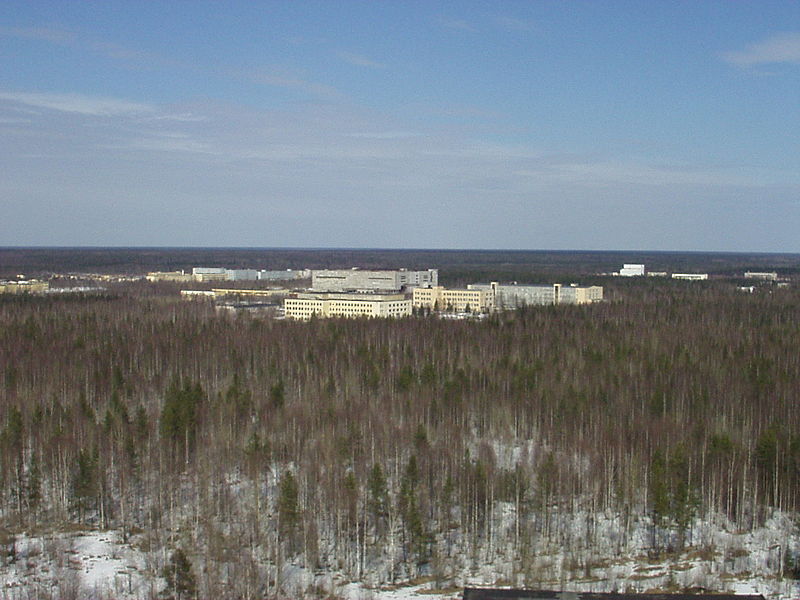
One of the MIKs. Similar technical structures can be seen in the background.
I am settling in, getting acquainted with my fellow servicemen and the surroundings. My unit 14056 (site 43) is stationed in the taiga on the right, southern bank of the Yemtsa River, a tributary of the Northern Dvina, near the former settlement of Skipidarny. Two launch sites with a common MIK and an oxygen-nitrogen plant. The distance between the launch structures is 300 meters. SK-3 on the left and SK-4 on the right. The launch crew of the unit carried out its first rocket launch on the night of 27 to 28 February 1961, from the launch position of my Tyuratam unit 33797. The town of Mirny—that is what the northern “ten” is called. There are no serious differences in service from the southern range. The climate is sharply different: moderately humid and mild, and around all the sites there is not dusty steppe but wonderful taiga, with the beautiful, clean Yemtsa River, rich in grayling, whitefish, and salmon.
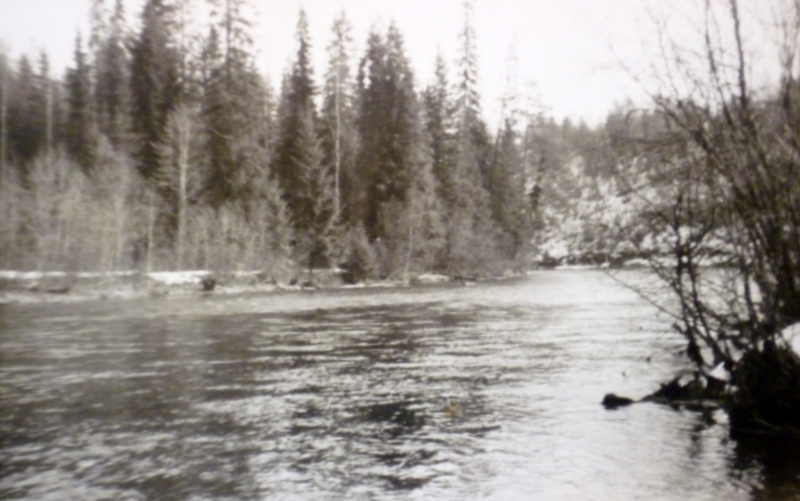
The Yemtsa River.
Many officers devote their free time to hunting and fishing. Sports are tolerable, although at a much lower level than in Tyuratam. A standard Officers’ House, just as in Tyuratam.
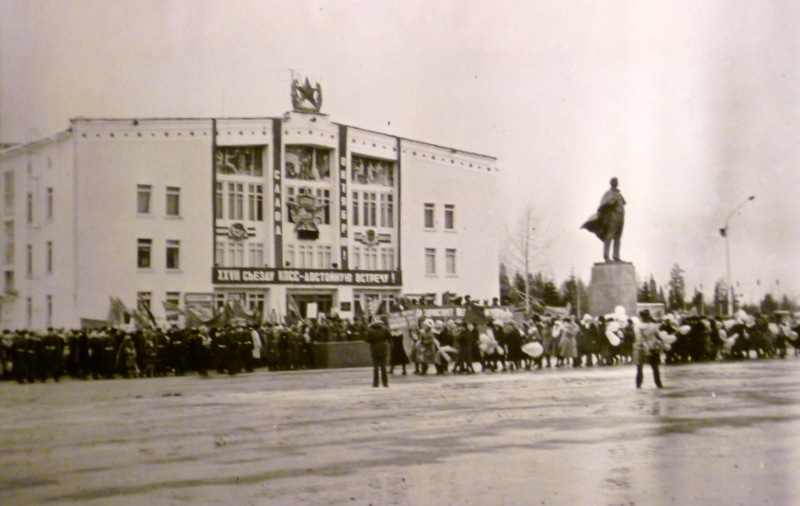
The Officers’ House. Passing the grandstand and the Idol, a column from the Novator Research Institute demonstrates something, with my Lena inside the column.
The cultural “programming” is weaker than in Tyuratam. But every year, without exception, the chief of the northern range, Boris Shtokolov, came and sang! A fellow countryman twice over. Born in Kemerovo and a Solovki cabin boy in his youth. Soloist of the Petersburg Mariinsky… Yes, we listened to that bass voice. What a thing! The “ten” itself is on a considerably smaller scale.
I throw myself actively into the work, taking upon myself the search for faults and the repair not only of my own equipment but also of that belonging to adjacent units. This was especially appreciated on Mondays and after holidays. Telemetry specialists are just like everyone else and have the right to “rest” on weekends. All the more so since regulations had not been abolished, nor had special operations. In the unit, special operations meant everything connected with preparing and launching the vehicle. And for all that, not a step without the main consumable material, the kindly little spirit. And how can one fail to celebrate a successful launch?
Before the New Year, the range headquarters needed a competent specialist for the new trend in the Missile Forces—the deployment of semi-automated command posts—and my commanders hoped that, for a short while, I was sent on assignment to Mirny. Goodbye, motor locomotive, boots, Sam Browne belt, and duty details! The northern motor locomotive is no different from the southern one. The same carriages, the same soldier-conductors, and comparable distances. They do not play cards; they read or sleep. But the train travels not across a bare, windswept steppe, but through a corridor of tall pines and firs, arriving at the terminal station, also surrounded by beautiful trees.
My workplace at headquarters was assigned to me in one of the rooms of the 1st (operations) department, headed by Colonel Khokhlov. This, as is well known, is the main department at headquarters. My immediate superior was Major Yury Yemelyanovich Kulikovsky. A kindest man, a sapper, a veteran of the range, a fisherman and hunter—a dog enthusiast. He kept a Laika. His wife was a master taxidermist and made wonderful stuffed animals. His two daughters entered the Kirov Institute’s hunting management faculty. So in the operations department, in such a healthy and friendly atmosphere, one could serve without knowing any grief. True, as far as engineering knowledge in the profile of this headquarters service was concerned, to put it mildly, there was rather too much for my subject. I would have been more useful working in any radio-electronic field, but at headquarters there was only one radio department besides the communications department. It was number 10, the EW department—radio-electronic warfare and electromagnetic compatibility. In that department I had my own man, Senior Lieutenant Tolya Vlasenko, a graduate the previous year of Mozhaisky’s 3rd faculty, who stimulated and supervised my transition from an attached officer to a regular member of the headquarters staff.
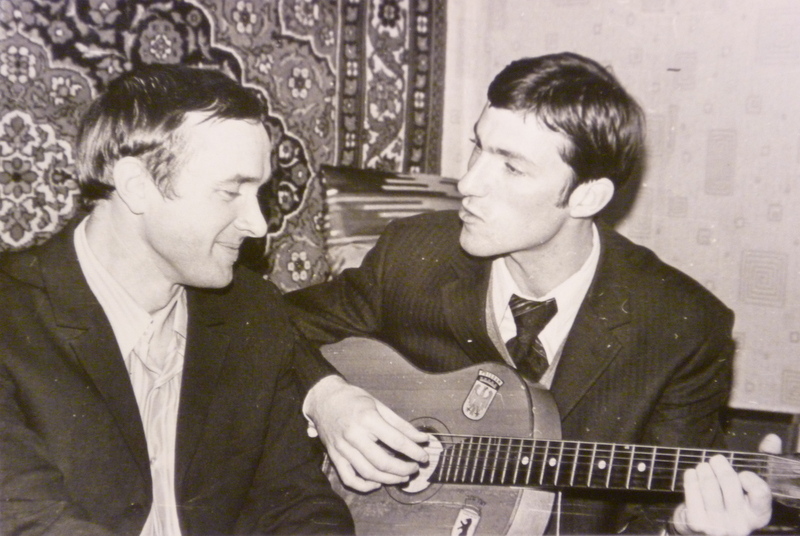
Is Tolya singing something to me?
A couple of months later I was invited to a conversation with the head of the 10th department. (EW), Department head Colonel Vladimir Ivanovich Yershov.
And then one day Tolya tells me that, as he understood it from a telephone conversation between the department head and the commander of my unit concerning my candidacy, I had been described over the phone in anything but a favorable light. It should be said here that during my assignment to the main headquarters, the commander of my unit had changed. Lieutenant Colonel Tatyankin had been put in place of Colonel Bugor, and I did not know him, nor had he ever seen me. It later turned out that he had not said anything nasty, but had hinted that Yershov would supposedly have a very hard time with me. Yet that bastard Tatyankin had never seen me in his life, just as I had never seen him. I immediately went to the unit, burst into his office, and put the question to him: Why, and why so underhandedly?? And he calmly replied: “You should serve with me a little longer!” We did not talk for long. I realized that he was quite well informed about me, but the boor did not apologize; instead, he promised to call his friend Yershov and straighten everything out. As it turned out, they were old and dear friends. And that is how I ended up in the EW department.
The department was engaged in technical counterintelligence, that is, covering the range’s activities through every possible channel of information leakage, the most “leaky” of which were radio and radio engineering.
Each department officer was assigned specific areas and topics of testing. I was responsible for all airborne and ground-based radio and radio-engineering systems of the 2nd Test Directorate (launch vehicles on the “seven-based” platform—11A57, 8A92, 8K78, 11A511U, and a mass of reconnaissance, communications, and navigation spacecraft). The common feature was that everyone in the department was occupied with some kind of measurements, but not a day passed without paperwork either. The endless research projects 1 tormented us.
The department’s subordinate unit had several special radio-control and reconnaissance vehicles. A great many measurements were carried out from airplanes and helicopters. Several times I had to visit a number of northern ports where we had stations for suppressing the enemy’s reconnaissance assets. In particular, from the Barents, White, and Kara seas, the range was under the influence of reconnaissance assets installed on RC-135 aircraft, “Orion” aircraft, and foreign merchant vessels entering the northern ports that had been additionally equipped with reconnaissance equipment. Besides space-based assets, the most dangerous were the high-speed SR-71 “Blackbird” and the radio-electronic reconnaissance ship “Mariata.” The separation of the warheads, the formation of the battle order with decoys, and the operation of the onboard telemetry and trajectory systems in the area where they fell in Kamchatka were reconnoitered by the Wakkanai RTR post (Japan) and a large ship, of the same type as our “Yuri Gagarin,” the “General Vandenberg.” There was a lot of work, and it was interesting.
Sometime in 74 and 75, after yet another skirmish between the Israelis and Arabs, our General Staff suddenly realized that the armed forces were dangerously behind in PPRDs (single-use jamming transmitters). They were also called ZPPs (throwable jamming transmitters). A competition was announced, the range joined in, and I headed a development team. There were six of us. Three sergeants, two lieutenants, and me. Excellent conditions were created. Two large rooms in a separate building, unlimited material support, a reconnaissance vehicle with a driver, and the department head’s confidence that I would manage to produce something.
But not everything worked out, and not at once. I went to Petersburg for a consultation, to my native academy, to the transmitting devices department and the AFU department. As it turned out, they too had joined in developing their own ZPP. The work completely absorbed me, and everyone else as well. I often left for home after 11 p.m. We tested the prototypes at the range’s main communications hub. It was a fairly serious establishment, and the communications officers on the duty shifts openly grimaced unfriendlily when I appeared, but they could not throw me out. I had clearance and an order. We were permitted to jam only on assigned frequencies, but it was still an emergency for them and was recorded in the duty shift’s documentation. By their own regulations, they were obliged to restore a lost channel, and in a very short time!
When I found the right transmitter configuration, the communications people were in for complete disaster. During another live test, I settled into a corner of their communications command post with my sergeant and, through my R-105 field radio, gave the necessary commands according to the communications table to the men in the SRKR (a reconnaissance and control station based on a GAZ-66). At that time our vehicle was in one of the designated locations, previously agreed upon and coded in our communications table. Naturally, beyond the communications hub’s territory, on one of the forest roads. During pre-New Year outings, conveniently combined with cutting down New Year’s trees, the men took Tanya into the vehicle a couple of times, which I regretted when I heard her little voice during one session: “Dyuk, come in! Dyuk, come in!” She had copied the frequently repeated commands. One of the lieutenants had thought to give her the microphone. But Slava Dyuk, a lieutenant, was supposed to be at our stationary radio-control post in the area of the security battalion, 10 kilometers away, listening to the overall jamming picture. An irregular, dangerous moment, since conversations on mobile radios were monitored.
Our experimental jamming transmitters operated exclusively from the body of the SRKR, because leaving them on stumps or in trees was dangerous. The communications men would find and wreck them. At every communications hub, a unit of “fox hunters” was kept ready, tasked with detecting and immediately destroying PPRDs. And were we supposed to risk our goods and our health? The effectiveness of the jamming could be assessed visually by the speed of the communications men’s running around, switching and replacing some blocks, frantically clicking switches, and the nervous squabbling that began at the command post. The nature of the jamming and its parameters were different every time; the search was under way. That made it difficult for the communications men to wriggle out of it. How they hated us!
Interestingly, the most successful solutions to emerging problems came not from rereading patents or radio-engineering bulletins, but literally on the toilet. And then it was time to deliver the product. We completed it on schedule, in three months. We packaged the device as an ordinary gas mask, and I took it to the Main Headquarters of the Missile Forces. I learned how the tests had gone a week later. My brainchild was awarded 2nd place. First place went to the specialized research institute. And I am not sure the decision was fair. Nevertheless, at the range and in the department, it was received very positively. Moscow handed over good money, which was divided between two people: the department head, Yershov V.I., and me. No one was offended. The sergeants received 180 rubles each! True, the creative work was not free of unpleasant incidents either.
One day a KGB major, the curator of our department, summoned me to his office. I had met him earlier—I had repaired his television once. So Boris, that was his name, began reprimanding me for telling jokes about Brezhnev in the presence of my subordinates. In those days, any social conversation or business discussion was considered tactless if begun without a new joke about the mumbling-and-kissing giant, and in general about the giant not only of party thought. I categorically denied the accusation, being completely confident in my group’s loyalty! Then Boris, God bless him, took a sheet of paper from the safe, covered its top and bottom with clean sheets, and said: Read! I was simply stunned. It was Tolya Kurchev’s handwriting, my fellow academy student and current colleague in the department, a lieutenant colonel and loyal Leninist. And the bastard had only come by a couple of times to look over our affairs, as if in passing. A regular informer, however. (Tolyan naturally rose as high as colonel.) I swore to Boris that I would never relax again. Such surprises occur in the course of creative work.
It was also part of my duties to “search” the visiting “brother democrats” who came to the launch site under the Interkosmos programme. On the day these “friends” arrived, they were treated to a grand programme of entertainment and amusement, with fishing, hunting, singing and dancing. During those 4-6 hours, accompanied by a security officer, I had to inspect the contents of the crates in the hotel and at the MIK for reconnaissance equipment. I was not interested in rags—only equipment. That was where I saw measuring equipment of a thoroughly modern standard! Exclusively American, West German and French. Miniature, with splendid specifications. If a foreigner arrived not with the group but late, say by several days, the work became more complicated. I had to examine, in a short time, the ground equipment already engaged with the satellite, while understanding practically nothing about it. And I could not ask any of my own people. My business was highly “delicate,” and in the department only the chief knew about it.
At the head of the department’s “prompting,” I decided to take the candidate’s minimum exams. I had long had more than enough material for a dissertation. And I had seen fresh candidates myself who were by no means “seven spans in the forehead,” but I soon cooled off. It turned out that here too one had to take a minimum exam in Marxism-idiocy. What a business. At once I had an excuse not to strain myself and to abandon the idea. I am lazy, after all.
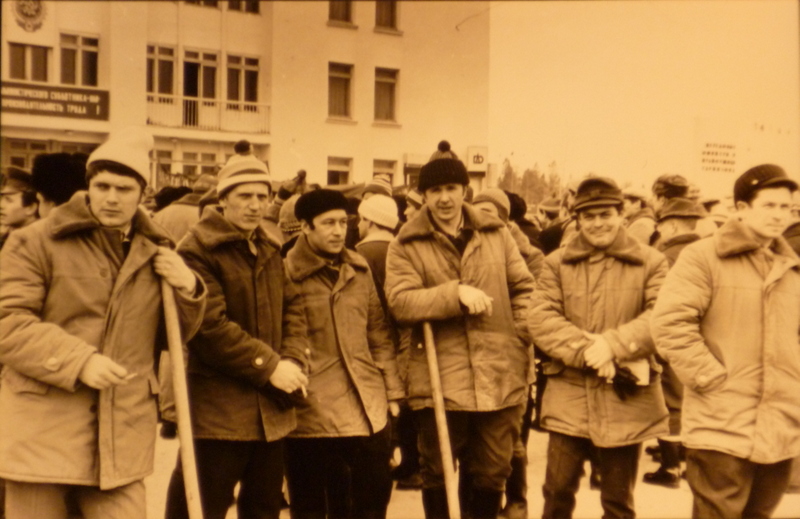
At the community workday near the Officers’ House, led by Vladimir Ivanovich Yershov (far right, gazing into the distance). Then, moving left, are the smiling Misha Murzin, the author, Tolya Kurchev, an unknown man, and Misha Yungov. It is clearly visible that Tolya is “keeping watch” here too.
In general, the informer as a type, as part of the community of Soviet people—the builders of communism—has not been properly revealed in literature and seems almost mysterious. But there is no romance in it. Our Tolya served in the unremovable mask of an extremely concerned man of business. He did not reach for the stars. Taciturn and thoughtful. At Marxist-Leninist seminars he did not stand out through excessive activity, and even as far as sycophancy was concerned, I cannot remember anything especially damning about him. And how many of these gray little men were there, if every department had at least one? And on the scale of the country? They live out their retirements with a clear conscience.
If my contact with an informer (or the informer’s attention to my person) ended quite innocently, my father’s story conjures up a very different bend in life.
In 41, in Kemerovo, people began disappearing from the factory floor. The workers whispered, and some even openly pointed to one of their own, an obvious informer. 2 And when Father felt that this loyal Leninist was getting close to him, so to speak, showing an interest, then, in his words, “it became so bitter—you were born… I thought, I’ll kill the bastard; it couldn’t get any worse. I grabbed some piece of iron and chased him around the workshop, but the workers intercepted me. And it worked— they did not touch me.” For that alone, to my dying days I have felt nothing but hatred for that party. This is how they corrupted the people with their damnable worker-peasant dictatorship. They probably raised millions of informers. I quite admit the thought that Father joined that party in 41 for reasons that were not necessarily loyal.
On the department’s EW assignment, in July 81 I flew to Kamchatka, to the settlement of Klyuchi. It lies right beneath the Klyuchevskaya Sopka volcano, on the Kamchatka River. Beautiful as a postcard. We flew there and back on an IL-62. I did not sleep during all 8 or 9 hours of the flight, but tried to identify the landscapes passing beneath the wing. The visibility was simply perfect for observation every time, but I could not locate myself without the flight attendant’s hints. The airplane’s route was laid not along the parallels at all, but much farther north, along a wide arc, if viewed on a map.
At Yelizovo, Kamchatka’s main airfield, we approached from the ocean, and suddenly “Boat! Boat!” spread through the cabin. Everyone went to the windows. Beneath us, at full speed toward Petropavlovsk, a black sausage-shaped thing was racing, without bow or stern. But the breakers and foamy wake gave away its power and speed. And there was the base to which the sausage was hurrying. We saw six more of the same kind, one beside another. The Kamchatka flotilla. How tiny the city’s high-rises looked in comparison with them! We were struck by the enormous underground shelters for combat aircraft. From Yelizovo, we made a hop on an AN-24 to Klyuchi airport. It is near the Klyuchevskaya Sopka volcano. The highest mountain on the peninsula and possibly the most beautiful. A symmetrical, snow-white cone with a slightly “broken” tip. And wherever you look, your eyes meet distant and not-so-distant high mountains. The nearest volcano is Shiveluch. All of them are active or extinct volcanoes. And the inhabitants of Klyuchi look at such beauty from morning till night! Everything is unusual and remarkable. Beginning with the feeling of a lost night after arriving on the peninsula. While we were flying, a new day had begun for them here. Ours was ending, and we had not completed it with a night’s rest. So during the first week we walked around somewhat dazed, adapting to the time zone. The food in the canteen was unusual. The menu was dominated by every kind of sea fish and crabs. The ground beneath one’s feet was unusual, gray-black. Not really earth, but coarse sand. It was all volcanic ash. Birch trees with thick trunks, very spreading. Tall, dense grasses. Small fields with powerful potato tops and enormous heads of cabbage. Every morning I was driven to the airfield, my work sector, and every time my escort pointed out fresh bear tracks. They were perfectly visible on the compacted dirt road. And according to the natives’ stories, there were bears galore in Kamchatka. Hunting them was forbidden. I looked at photographs of winter landscapes and everyday life. Two-story residential houses had a genuine entranceway with a canopy and steps built onto one of the roof slopes. When a lot of snow fell, residents stopped clearing the lower entrance and began using the upper one. According to meteorological data, in some winters up to 5 meters of snow fell in these parts! Our fellow Tyuratam man, a graduate of our 33797 who had served five years as head of the OBATO, 3 Tolya Panfilkin, answered my question about service in Kamchatka briefly: “Fighting the snow!”
During the assignment I managed to do a little fishing on the Kamchatka River. Now that was fishing, and fish! The line was millimeter-thin, the lures heavy and as primitive as blacksmiths’ work. I shot a decent film with views of the mountain. On the way back, immediately after takeoff, at the request of our senior officer, the general, the pilot made a circle around the volcano’s crater. Impressive! We returned to Moscow at the very same hour at which we had departed from Yelizovo. One could simply stop one’s watch for the duration of the flight.
As an active inventor and rationalizer, I was appointed secretary of the range administration’s commission, and somewhat later the general assembly elected me a member of the administration’s officers’ court of honor. And I was non-party, after all. Apparently, there was a shortage of honest people among our communists. Because of this notorious party affiliation, I remained a major until my discharge. And how many petty meannesses and direct attacks from the new department head, Colonel V.P. Shumilin, I had to endure. All just to herd me into the common pen. He, of course, took the blame for me. The only non-party major in the entire range administration, and in his department. A disgrace! Then the time came for him to defend his doctoral degree, and he became afraid that I would cause him problems. Persuasion did not work on me, so he decisively removed me from the board of outstanding workers and stripped me of the title “best specialist”; worst of all, he began sending the young officer Shura Zinchenko, the secretary of our party cell, a sycophantic little fellow, to talk with me. And this after almost ten years of my service in the department.
I went to see the chief of staff, General Vasily Vasilyevich Kurbatov, and asked to be transferred anywhere. A day later V.V. summoned me and promised, “I will reconcile you,” which did not suit me at all; “Valyok” would not have left me in peace. I was already thinking about where to serve out my remaining years. But that same day, or a little later, I met Colonel Rudolf Afanasyevich Rzhanitsin. He was chairman of the range commission on rationalization and invention, where I had already been his uninterrupted secretary for nine years. “You are fighting Valentin Petrovich,” he said, “so come to me!!” What a gift of fate! I had not asked for it; I was being invited. R.A. was head of the warhead testing department. I had previously crossed paths with some officers from his department in my work.
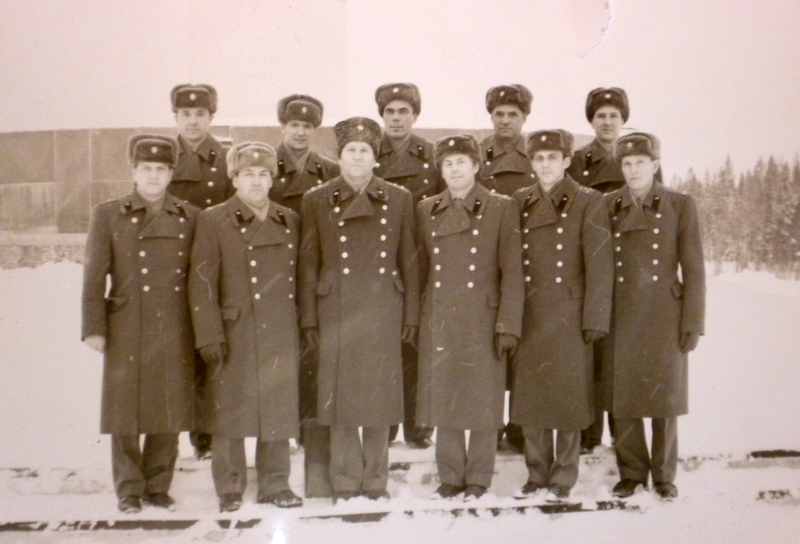
Headed by Rudolf Afanasyevich. Beside me are Sasha Ivlev and Vitya Burtsev. At the bottom, first on the left, is Vova Sentishchev. To R.A.’s left is Zhenya Korolev.
Could one wish for anything better? I immediately agreed. Then I spoke with Lena. I convinced her that my work had nothing to do with radiation. The work was actually in my engineering specialty, that is, with radio-engineering systems, but it involved a great deal of specialized knowledge. No testing outside the shielded chamber, and technical discipline in general was at a higher level. I was sent on assignment to Arzamas-16 for training for 20 days.
They probably would have taken us to “Forty,” and I would not have guessed that it was a completely different city. Both of these closed cities were created at the same time, and their housing stock was indistinguishable. Only Chelyabinsk-40 was built on bare ground, while Arzamas-16 stood on the territory of a venerated ancient monastery, with the principal monastery buildings preserved. Cleanliness and good upkeep, as befits a normal cultured city. (Why, then, in every open Russian city are dirt and squalor found practically at every step? Could it really depend on the residents themselves, on the percentage ratio of normal people to proletarians who have “nothing to lose but their chains,” and thus determine the convenience and comfort of living?) The main road cuts in a broad arch beneath a very tall and beautiful bell tower. And in the building adjoining the bell tower is the famous VNIIEF, the All-Russian Research Institute of Experimental Physics, the developer of the USSR’s nuclear munitions. It is here that the “filling” for equipping the devices arrives from the closed cities that produce fissile material. And on the subject of “who is more important and who should be considered the parent of the first bomb,” it was here that I argued with the local engineers. Patriots of their Arzamas, they naturally considered themselves the progenitors of atomic weapons, and not “Forty” at all. Well, let them think so.
We went around the shops to buy something edible for the hotel, as well as presents for our people in Mirny. The shops were bursting with delicacies unimaginable in Mirny’s military-trade stores. I had long since forgotten about the special supplies of the atomic cities. My comrades’ eyes darted around, their little hands itching. This one, that one, and this one? But the salesclerk immediately cooled their enthusiasm by asking them to produce some special coupons or cards valid locally. Cleverly devised! The dear guests got to sample the treats. Only ordinary food was freely available. Later, once we had settled in, we obtained those special scraps of paper from locals and went shopping. From then on I was a “bighead.” Father had helped create the warheads, and I helped test them…
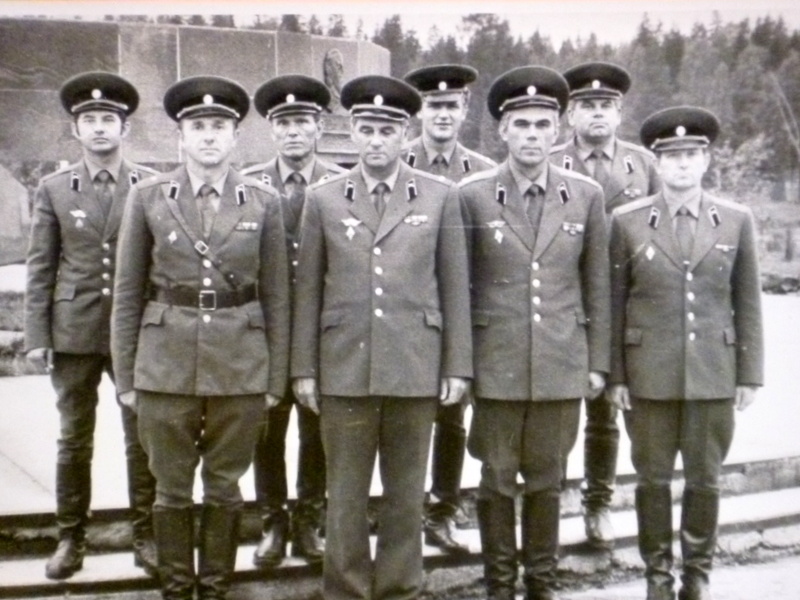
And this is already under the leadership of the new department head, Vitya Burtsev, second from the right. I stand out with my Sam Browne belt, and Zhenya Soskov with his smile. The other “bigheads” have intelligent faces. Vova Sentishchev, known to the people as “The Tick,” is taking the photograph.