Chapter 24 of 29
Hunting and Fishing
On the advice of older comrades, somewhere in the 73rd year I got in line to buy a motorcycle. Now that sounds strange, perhaps, but in our years of total shortage it was ordinary. At the same time I got in line for a kindergarten. People separately signed up to buy carpets, furniture, refrigerators, washing machines, crystal, cars, and motorcycles. There were no entries in those queues controlled by the party committees except in grocery stores, and even there, in the Brezhnev years of ‘abundance’, lines for milk, meat, cheese, and sausage appeared, soon ‘ordered’ by a coupon system.
About a year later my turn came, and I became the ‘lucky’ owner of a sidecar motorcycle, a Dnepr-MT9. I was immediately struck by how much junk was on it: nuts, washers, and scraps of wire, all smeared and stuck fast with paint to the sidecar floor. Where, in such a factory, was the factory inspection department? Then the gearbox failed. I disassembled it and pulled out the main axle with several gears on it. One of them had broken teeth. I took it to the GAI to file a warranty claim against the plant. At the GAI they said that this axle had been taken from scrap metal and it was strange that I rode this two hundred kilometers. Then both rear shock absorbers failed. The factory had simply grooved water pipes, not even cleaning the inner seam. But the inner surface of those cylinders should be polished. To top it off, the head of the right cylinder cracked. The crack ran through the valve saddle. This happened on a farther trip. The engine started chvakhing through that slit, but it made it home. The factory answered no complaints at all. There were no Ural or Irbit motorcycles for sale, because dear voentorg bought only these nightmare products from the Kyiv motorcycle plant. Planned economy, in any case.
So this scooter was what carried us around the area. In autumn, for mushrooms, lingonberries, and cranberries. Sometimes we filled the sidecar completely, and only with caps. In a good year of lingonberries we collected in one outing as many baskets and buckets as we could carry away. But you can’t dump it all into the sidecar. And in winter, hunting and fishing! Winter riding on a motorcycle is especially good for ending the trip. Even at the smallest temperature, the headwind burns your face; tears and snot fly. But once you stop, there is Tashkent and bliss. To get into closed sectors of the test range, along service roads through checkpoints, Lena lay down on the sidecar floor; I covered her and moved on. I had an all-terrain pass. Lena was always afraid of the checkpoint dogs that barked at the motorcycle. She always felt they could smell her. She loved riding our motorcycle very much. Especially for mushrooms, berries, and swimming in Syamg Lake. This is how we sat: Lena on the back seat, and Tatyka in the sidecar with baskets, buckets, and food. The seat there is quite comfortable. I began teaching Lena, as proper, gradually: first without the motor, then with the engine running but on a stand. ‘Accelerate, I don’t want to!’
And then finally that wonderful freezing day of practical riding came. It is worth noting the excellent quality of the internal roads of the test range. All of them are concrete and wide. In winter they are cleared right down to the concrete. On weekends they are completely without cars. We crossed for the start a couple of kilometers from the city and in a fine frame of mind I seat Lena—the kolobok—with what seemed to me the last, and unnecessary, parting words. A kolobok, because she was dressed in new army quilted pants and jacket, and a fur hat on her head. The driver’s hands are short, so she is almost reclined on the motorcycle, gripping the handlebars with three-pronged, also army winter mittens. That grip did not please me at once. From nerves she answered me, not turning her head. She was already in flight. I allowed, or rather with shouts, forced her to release the clutch. After all, we had gone through all these operations many times before, on the stand. It squealed and at last released the clutch. Better she had kept squealing, but she did not touch it! I pushed, nuzzled lightly alongside, and encouraged, fool that I am. I thought we would ride a little and stop, rethink, cool off. In other words, work through the mistakes. But Lena already had something of her own in her head, something womanish.
At that moment she could do only one thing. Either ride or brake. No pleas from the instructor to stop were heard by her. She heard them, but only to shriek, ‘I can’t!’ and yet she pressed the throttle. Her eyes were fixed somewhere ahead; she was shouting and accelerating. I could not take hold of the handlebar, it was dangerous. I was already falling behind. I too was dressed in all padded clothing. I shouted the last useful instructions, grew silent, and walked after the motorcycle disappearing into the bend. Most pessimistic thoughts. The tank was full of gasoline and the road was over 70 kilometers long. True, there were two checkpoints with boom barriers on the way. What else to do? We had to go. About twenty minutes pass, and I hear it rattling. It turns out that on the way she suddenly remembered everything, shifted into neutral, swung the cart around in a turn, and came back. What joy.
My first outings for hunting were under the supervision of Yuri Yemelyanovich Kulikovsky, a major of the 1st department. It turned out that shooting a capercaillie was not so difficult, especially ‘from the porch’, from a car window, or from a little towed cart. Harder is to handle the game in your hands if it is not more than 30-40 meters away. In Arkhangelsk Province, deep loose snow was already lying in November. I lunged in, took several steps, and hung there, helplessly shaking my legs above the hard ground without touching it. That is why the best hunting is in early winter, in shallow snow.
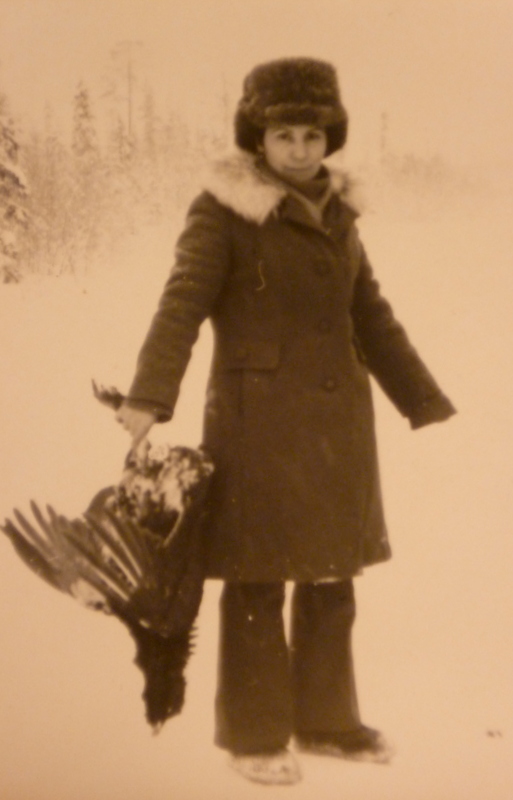
I got hunting skis through an acquaintance forester. For 25 rubles. At the time, the price was very high. Length around two meters, width a little over twenty centimeters, and lined underneath along the whole length with camus, moose hide with guard hairs. Heavy, yet they gave absolutely no kickback. You walk uphill without poles and do not even tense up in anticipation of sliding backward. But the most successful and rewarding hunting happened in company with Lena. She discovered the gift of search—the searcher. Sometimes she went in a completely opposite direction from the one where, in my opinion, the wounded teter was meant to go. And she was right. And finding the bird, even after tracking the trajectory of its fall, is by no means simple. In the taiga the snow is extraordinarily fluffy and a fallen bird, though black in plumage, disappears at once, sinking in.
I bought an optical sight and mounted it on the melka. Things became more cheerful. I had worked out the capercaillie. Attempts to take a hazel grouse began. Every winter I spent it in these completely fruitless attempts to get one. I put on a masksuit, wrapped the weapon in bandages, gave up skis so as not to make noise. I came home from the hunt soaked through and without game. The hazel grouse never let itself get near a shot. I was always lacking a couple of steps to the proper distance. The bird’s hearing is astounding. And still I made out winter hazel grouse. I noticed that toward evening, especially at first dusk, the hazel grouse loses vigilance. It has already packed its crop with pine needles, is sated and satisfied, and settles on the top of the tallest pine to prepare for sleep. It is in those brief minutes that you can approach to an accurate distance. After a precise shot, the bird soars vertically upward, ten meters, and immediately drops. Just as surely as with the wounded capercaillie. But if the shot is not lethal, then watch carefully where the bird plans to fly.
Spring hunting on a teter lek is beautiful. Not all the snow has melted yet, and the taiga is buzzing with capercaillie murmuring from morning to night. It is extremely far-reaching. At first you do not know where to go or where the nearest lek is. You can circle all day and fail to find the lek area. The murmuring comes from every side. I found my own lek by accident. On the edge of a small glade there stood a hut made of quite thick bare branches, full of holes on all sides, with an entrance slit from the side of the glade. Classic, as from a hunting guide. On the next free day from duty, I spent the night in the forest, a hundred meters from the glade, just in case. I made a fire behind a large fallen tangle of trees, boiled snowmelt in a tin can repurposed as a kettle, drank tea with pleasure, and lay down on prepared larch branches. By then I had already given up the thermos, too heavy to carry for long, with the rifle, the shotgun, the felt boots, and since I was dressed warmly. Felt boots so I could sleep warmer and lie in the hut comfortably. Also, the way to my grounds is winding and long.
In those parts movement was forbidden on weekends and for non-service matters. But I already had a Zaporizhets. On Friday evening I drove to Ur-lake, left the car by it, took the bicycle off the rack, bypassed the checkpoint, five kilometers at least, and pedaled for about twenty minutes on concrete. I turned left, dropped the bike in the bushes, and then went on foot along an old but quality corduroy road for another forty to fifty minutes. The corduroy crosses two streams, about 5 to six meters wide. The bridge supports are laid as larch log cribbing. The corduroy itself, the road surface, is made from logs of various species, so some of the logs have rotted in part. Everything is lashed together with heavy clamps. After about a hundred meters there is a widening for passing an oncoming logging truck. Through swampy sections the road is covered with logs in two and three layers. Such logging operations are expensive. You walk, your heart singing with the spring chorus of birds, and from time to time you imagine how, on this and similar roads, in summer and winter, in any weather, under the watch of the guards, Soviet convicts dragged this heavy strap for long terms. But then comes a landmark: a huge stack of discarded, half-rotten logs. I turn left off the corduroy and my heart starts to beat harder.
Toward dawn, and with the night short, I moved into the hut and lay down properly. You should lie either on your side or on your stomach, not on your back. But my first morning in the hut, I woke and was lying on my back. From all sides, it seemed, titeres were singing by my ear and under me. One was certainly sitting right on the hut. And I sprawled, while the gun was off to the side. The hunter. Sunshine was already drilling through the gaps of my shelter. I began to turn onto my belly. It took about ten minutes. I was very tired. My God! They had set their dances and scuffles less than ten meters from me. They chuck, hiss, murmur. They clash in fights, chest to chest. The combs are red, the feathers blue-black, and beneath the tail fan snow-white. Some run about the clearing aimlessly, some chirp by themselves, and the main part of the flock walks importantly like village dandies. And all this performance is for a gray mottled little capercaillie perched on a nearby birch. Fearing they would see me, I began to look at them with my eyes narrowed like a Chinese man’s, slit-like. Viy came immediately to mind. Then I had to take the gun somehow. Another ten minutes of slowed movements. Good that it was cocked. I took a very long time choosing where to shoot. You cannot shoot the close ones, the shotgun spread is too broad. I chose the moment and dropped three. More than three on this lek could not be taken.
Hunting on a lek is good, but relatively passive and requires mainly patience and calmness. Hunting from approach demands entirely different requirements. And a completely different emotional level. This is the highest class of hiding game; it’s who outwits whom here. You act like a predatory beast stealing its prey. First of all, you must decide on a route for approach or crawling. The main enemy in this is dry twigs underfoot and your hunting outfit contrasting with the color of the surrounding shrubs and trees. But the most important thing is being able to stop at the maximum effective shot distance, without making ‘one more last step’. For exactly after that step the game can no longer endure your wriggling; it has already gotten a hold of you and simply did not yet want to leave a well-hidden perch. You make that foolish step and immediately hear a loud flutter of wings. Hello, hunter! You should have crept one or two hundred meters farther over the snow, or on all fours behind bushes, soaked to the string, and so foolishly scared the bird. Enough, go out to the nearest big clearing, better to a knoll, and see where your clients flew. Or maybe you will find nothing else for the whole day, Lopukh. But if you did everything correctly, calm your breathing. Slowly and slowly, choose a gap between trees so the bullet does not strike even the thinnest twig, estimate the distance several times so you take the right elevation, and begin aiming. Then a teter or a hazel grouse sits on the sighting point or above it. Press gently on the trigger, and if the day is clear, in the sight we can see the bullet rise slightly above the bird for a fraction of a second and then disappear as it falls. It is a hit. The game rises vertically upward several meters and under a small angle falls in disorder almost under a tree. One can take a breath and walk toward the trophy unhurriedly. Worse if the shot is not a hit and the bird tries to fly off. In winter, consider it gone. The snow is loose, and finding a soot-black capercaillie is practically impossible. The main thing at long distance is to determine where the bird landed. You can trample a hectare and it lies somewhere nearby, but until you nearly step on it you will not find it. But if I am hunting with Lena, success is almost guaranteed. She has a gift for tracking, a sharp nose. Sometimes she goes in a completely wrong direction, as I am certain, for the search. And she finds. You can be proud of this, and she likes to put forward her abilities when we remember our Miorniny times.